

5 Places in Schools that Need LED Lighting

Young students in a classroom with plenty of light.
Updated 7/23/25 by Angela Rogers
Schools and educational facilities can benefit from LED lighting in more places than you may think. Using LED technology can not only cut electricity costs in school districts and universities, but it can also help improve student learning and campus safety. Shown to improve mood, reduce eye strain, and reduce absenteeism, LED lighting has a direct impact on students, teachers, and the learning environment. Here are 5 places where traditional lighting doesn't make the grade and needs to be replaced by LED lighting.

A classroom with proper LED lighting can help improve the attention span of students.
Classrooms
Students and teachers spend the majority of their day in classrooms. Research indicates that LED lighting offers greater flexibility, increased focus, and comfort. One study on the impact of light on learning saw a 35% increase in reading speed and a 76% drop in hyperactive behavior during a year-long experiment.
Students under normal lighting were compared to students under light levels tailored to different activities, including higher intensity and color temperature during tests. By switching to LED, it also eliminated the distracting flickering and buzzing that is sometimes problematic with fluorescent tubes.

Students in a library having fun while working on a project.
Library
School libraries offer a quiet place for individual studying or collaborative projects. Lighting in layers allows for softer ambient lighting to be paired with higher intensity desk lamps for task lighting. Overhead, LED light fixtures placed parallel to book shelves reduce eye strain and provide the most even light down the aisles. Using indirect rather than parabolic fixtures makes the space feel more open and decreases glare on library computers or student laptops. When paired with occupancy sensors, schools can keep the lights on for late-night study groups while saving money in unused areas.

Stairwells and Hallways
There's nothing like a flickering fluorescent to change the vibe of a campus hallway or stairwell from a place of higher learning to the set of a horror film. Dark hallways and stairs can lead to accidents as well. LED lighting provides a steady, long-lasting light, reducing maintenance for high-traffic and hard-to-reach areas.
When upgrading, don't forget your emergency lighting. LED panels can be equipped with emergency backup ballasts to help students and faculty leave safely during a power outage or emergency. Exits should also be marked with exit signs. There are a wide range of LED options now available that meet most local and state building codes.
Lighting Tip: Other rooms in schools that can benefit from LED lights are bathrooms, science labs, storage areas, and offices.
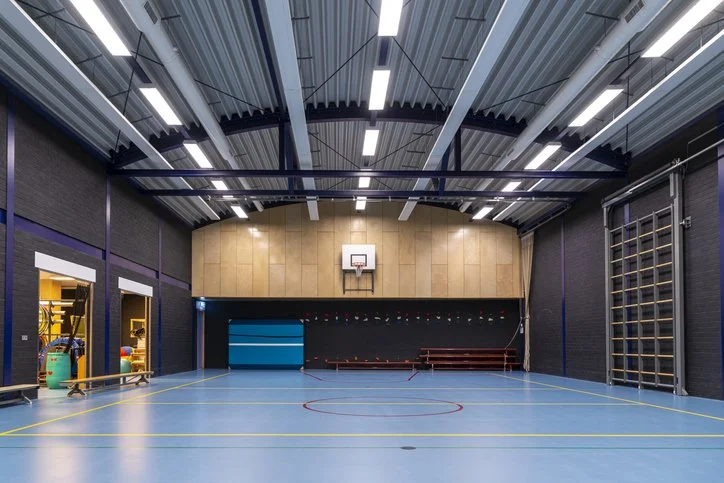
Large spaces like gyms need more light.
Gymnasiums
Gymnasiums are far larger spaces than classrooms and libraries. The amount of light required varies depending on how the room will be used. For example, an elementary school gym will require less light than a college or university gymnasium where games may be televised. Official sports lighting is measured in footcandles (how much light per square foot).
Whether using metal halide or LED lights, the fixtures must be impact-resistant. A shower of glass down on players would make anyone rethink “any publicity is good publicity.” LED high bays frequently use a plastic lens, and some fixtures can be equipped with a wire guard to protect against stray balls.
Aside from lasting longer and requiring less maintenance, LED fixtures offer another major benefit: they have no warm-up delay. LED high bays and other ceiling lights provide instant light at full output with uniform illumination as soon as the switch is flipped. So, while the team warms up, your lights won't have to.
Lighting Tip: If you want a similar look to existing round MH high bays, look at LED round high bays. These fixtures come with acrylic reflectors, mimicking the look of traditional fixtures.
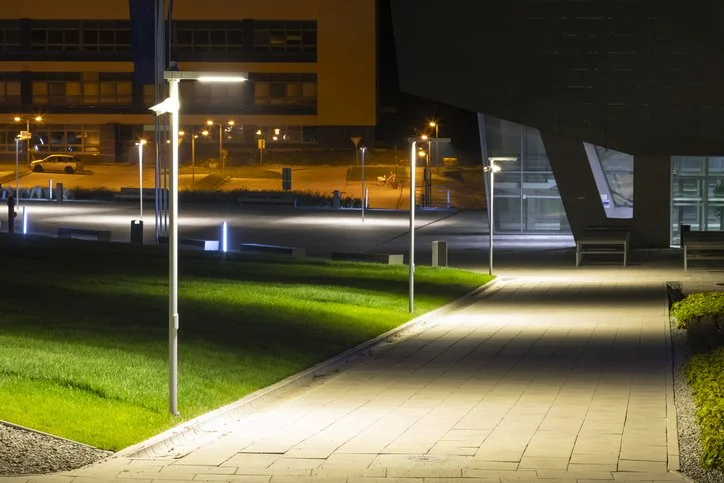
Parking lot using a combination of area lights and bollards.
Building Exteriors
Students and faculty need to feel safe when coming and going from campus. LED area lights are one of the best ways to provide better visibility in parking lots and other large outdoor spaces. The bright, uniform light of these fixtures eliminates shadows and dark spots, making parking lots safer for both drivers and pedestrians.
Another option is to use LED wall packs around building perimeters and walkways. These fixtures drastically reduce energy consumption, eliminate lumen bounce (amount of lumens lost inside an MH fixture), and provide longer-lasting, higher-quality light. Higher Kelvin light is commonly used for security lighting because it reduces shadow contrast, providing better imagery for security cameras. MH wall packs have a quick drop in initial Lumens and eventually turn yellow, while LED wall packs maintain the same color temperature for the duration of their life. LEDs can also be used in parking decks, landscape lighting, path lighting, wall grazing, and other outdoor applications.
Lighting Tip: Pairing your outdoor fixture with timers or photocells ensures your lights are only on when needed.
LED lighting passes the test in more ways than one. Whether you're looking to make your campus a safer place or optimize the lighting in classrooms, give us a call at 1-800-624-4488. One of our lighting experts can help you get started making a brighter future for young minds.