
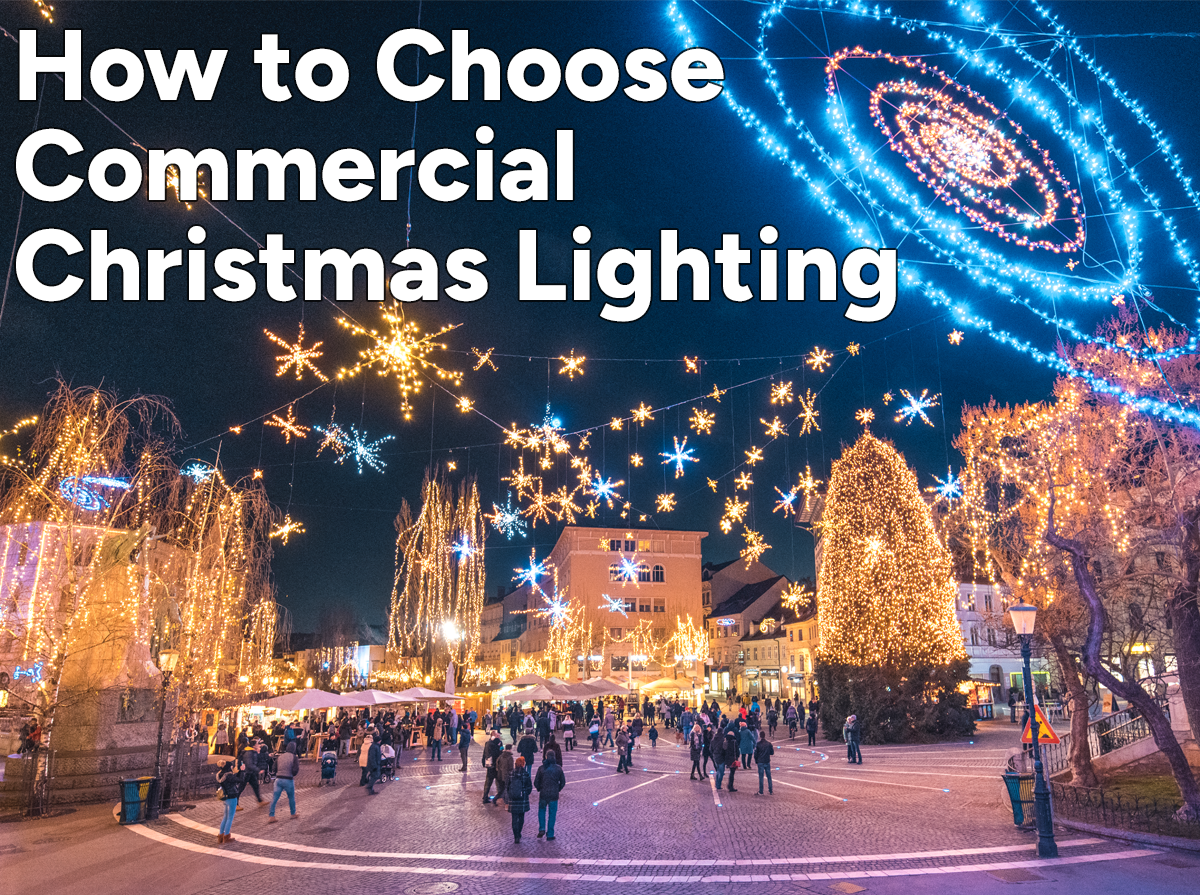
How to Choose Commercial Christmas Lighting for Any Property
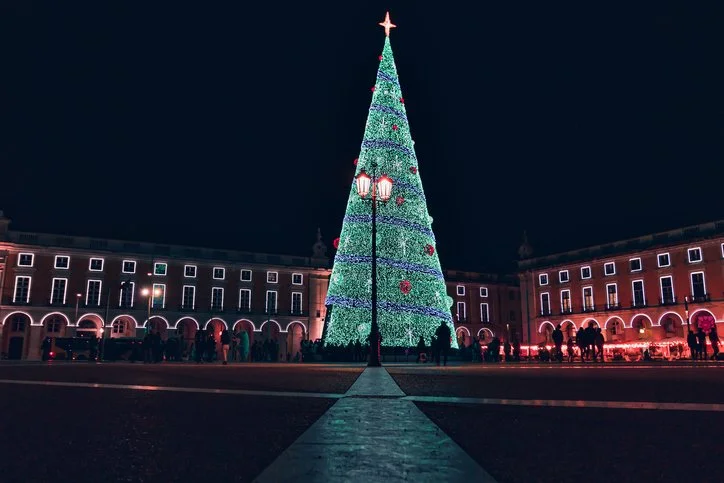
Choose commercial Christmas lighting by measuring your property, deciding on a look, and checking available power. Compare product specifications, compatibility, and maintenance needs before ordering. A commercial-grade label alone does not establish durability or outdoor suitability; the right choice depends on your site and installation plan.
What Makes Christmas Lighting Commercial Grade?
Evaluate commercial-grade Christmas lights by their documented specifications rather than assuming they outperform other products. Use these criteria to compare options:
Wire and insulation: Check conductor gauge separately from SPT-1 or SPT-2 insulation construction. Gauge affects current capacity, but the complete product rating and installation conditions also matter. SPT-2 has thicker insulation; that alone does not increase its current rating.
Sockets and connectors: Verify construction, compatible components, and required connection protection. Sealed sockets and locking connectors are product-specific features, not universal commercial attributes.
LED rectification: Full-wave operation can reduce visible flicker where specified, but does not guarantee flicker-free performance.
Environmental suitability: Check intended outdoor use, operating temperatures, and exposure limits. An IP rating describes protection against solid objects and water; it does not establish every installation condition.
UV resistance: Look for documented sunlight resistance, but don't treat it as approval for permanent installation.
Serviceability: Check replacement availability and warranty terms before choosing products for repeated seasons.
LED vs. Incandescent Commercial Christmas Lights
Commercial LED Christmas lights generally consume less energy than incandescent options for comparable applications. Compare actual input ratings, appearance, and replacement design rather than relying on a universal savings percentage.
| Factor | LED | Imcandescent |
|---|---|---|
| Energy Use | Generally lower | Generally higher |
| Heat Output | Generally lower | Generally higher |
| Rated Life | Often longer | Often shorter |
| Appearance | Warm, cool, and colored options |
Traditional warm look; color options |
| Replacement | Depends on integrated or replaceable design |
Depends on product design |
Warm white LEDs can support a nostalgic display. Compare samples to judge color and brightness, especially when adding to existing strands.
Rated life does not guarantee seasons of service. Operating hours, weather, wiring, and handling affect usable life. Include energy use, installation, replacements, and storage when comparing total ownership costs.
Types of Commercial Christmas Bulbs and Strands
Choose each format for its coverage, visual effect, and maintenance requirements.
Commercial Mini Light Strings
Mini light strings suit tree wrapping and detailed greenery. Compare bulb spacing, lighted length, and connection limits; verify wire specifications rather than assuming heavier construction.
Sealed and replaceable-bulb designs have different servicing needs. Check the product’s environmental rating instead of assuming sealed construction guarantees better weather resistance.

C7 stringer
C7 and C9 Stringers
C7 and C9 stringers offer separately selected screw-in bulbs for rooflines and perimeter outlines. Check whether bulbs are included or sold separately.
Common C7 replacement bulbs use E12 candelabra bases; C9 replacements commonly use E17 intermediate bases. Verify actual sockets, voltage, and load limits before ordering.
Coordinate colors within a run while keeping all components electrically compatible.
Icicle and Net Lights
Icicle lights create hanging drops along eaves and gutters. Match the horizontal lighted length and drop lengths to your intended roofline.
Net lights distribute bulbs across shrubs. Measure coverage dimensions before ordering; a suitable net can simplify repeated placement without forcing branches into an unsuitable shape.
Rope and Tape Lights
Rope lights enclose lamps in flexible tubing. Tape lights use LEDs on a flexible strip, with protective enclosures varying by product. Both can accent architectural details.
Neither format is automatically outdoor-rated. Check power-supply requirements, mounting methods, minimum bend radius, and permitted cutting points before planning runs.
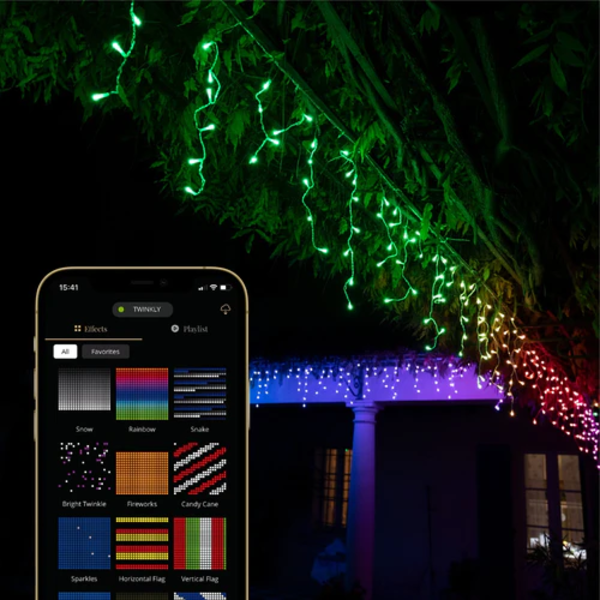
Smart Addressable RGB Lights
RGB mixes red, green, and blue light. Addressable systems independently control supported lights or segments for chases and animated focal displays.
Controllers may be included or separate. Verify power, software, and system compatibility, including which effects require an app or additional accessories.
Match Commercial Christmas Lighting to Your Property
Prioritize the areas people see and use most, then choose products that fit the site’s operating and maintenance needs.
Storefronts and Retail Centers
Highlight entrances and coordinated window outlines while keeping signs visible. Choose brand colors or a consistent white palette, and check brightness from the sidewalk and neighboring properties.
Preserve walking routes, accessibility features, and emergency exits. Plan mounting and service access so routine business can continue while the display is maintained.
Apartment Complexes and HOAs
Coordinate colors and spacing across buildings, entry monuments, and common areas. Standardize compatible bulbs and connectors so that replacements are easier to identify and stock.
Use secure mounting suited to shared spaces. Keep equipment accessible for inspections and servicing, and coordinate access with property staff before installing above busy entrances.
Restaurants, Hotels, and Event Venues
Choose comfortable brightness and colors that complement the venue. If dimming matters, verify compatibility among lights, controllers, and dimmers before buying.
Keep service areas and entrances clear. For patio lighting that will remain installed all year, select products explicitly designed for that use; seasonal suitability is not enough.
Large Residential Properties
Connect rooflines, trees, and landscape accents through a shared palette. Select a few focal areas to keep installation and maintenance manageable.
Commercial products do not require an oversized display. Plan safe access to high rooflines and mature trees, including appropriate ladders, lifts, or professional installation support.
Plan Length, Power, and Layout for a Commercial Display
Build a site plan before purchasing. Record each lighting zone, connection point, and proposed power source so you can check lengths and electrical requirements together.
Step 1. Measure Every Roofline and Run
Measure intended routes, including corners and peaks, plus tree and shrub coverage. Mark obstacles such as downspouts and vents. Use safe measuring methods rather than accessing elevated areas unnecessarily.
Record lighted length separately from unlit lead and end cords. Use the product’s stated dimensions; total string length does not always equal illuminated coverage. Mark connections and installation zones.
Step 2. Calculate Load and Maximum Connections
Start with the capacity of the circuit supplying your display. For continuous-load planning on a standard 120-volt, 15-amp circuit, the calculation is 120 volts × 15 amps × 0.8 = 1,440 watts. Subtract other loads on that circuit before estimating the power available for Christmas lights.
For identical incandescent bulbs, divide the available watts by the wattage per bulb and round down. For example, 1,440 watts ÷ 7 watts per bulb allows 205 bulbs by circuit capacity alone, assuming no other loads. This is not permission to connect all 205 bulbs in one run. For LED products, also check rated input current rather than relying on wattage alone.

Check each stringer, cord, controller, and connected-set limit; the lowest applicable limit governs the installation. See our guide to calculating maximum runs from wattage. Have a qualified electrician confirm uncertain circuit capacity or assignments.
Step 3. Map Outlets and Extension Runs
Identify suitable outdoor power with ground-fault circuit interrupter (GFCI) protection. Confirm which outlets share a circuit rather than assuming each has separate capacity.
Route cords away from doors and pedestrian traffic. Keep connections away from standing water and follow the equipment’s placement instructions. Plan how staff will disconnect and inspect each zone.
Step 4. Choose Wire Gauge and Color
Wire gauge describes conductor size: a lower gauge number means a thicker wire. An 18-gauge conductor is thicker than a 20-gauge conductor and, under comparable conditions, can carry more current. Most Christmas-light wire is 18-gauge; some of our 25-foot pre-cut stringers use 20-gauge wire. Longer runs increase voltage drop, so gauge and run length both matter when planning how many lights a run can support.

Our SPT-1 vs. SPT-2 wire guide lists 18-gauge planning limits of 10 amps for runs up to 50 feet, 7 amps for 51–150 feet, and 5 amps beyond 150 feet. Follow any lower product rating or maximum-run limit; do not apply these figures to 20-gauge stringers. SPT-1 and SPT-2 describe insulation thickness, not conductor gauge, so thicker SPT-2 insulation does not increase current capacity. Match plugs and sockets to the wire’s specified SPT construction. Once electrical requirements are met, choose green, white, or brown wire to blend with the display.
Accessories for Commercial Christmas Light Installation
Select accessories for your mounting surfaces, equipment, and power plan; not every display needs every accessory below.
Mounting Clips and Brick Clips
Match mounting clips to the surface, socket, and supported load. Brick clips must fit the brick dimensions and joint profile; many grip exposed brick edges where mortar is recessed.
Inspect reusable hardware for cracks or deformation. Follow the selected clip’s mounting instructions and load limits.
Outdoor Extension Cords and Connection Protection
Choose outdoor-rated extension cords with appropriate capacity for the load and run length. Check the markings and manufacturer’s guidance before installation.
Use compatible connection protection as instructed. A cover does not make indoor equipment outdoor-rated or authorize submersion; keep connections away from standing water.

Timers and Photocells
Timers set operating periods; photocells respond to ambient light. Choose the control method that fits your display schedule and site conditions.
Check switching-load ratings and lighting compatibility. Avoid unnecessary overnight operation, and use your actual electricity tariff and operating hours when estimating costs.
Bulk SPT Wire and Insulation-Piercing Plugs
Bulk SPT wire and insulation-piercing plugs, often called “vampire plugs,” are options for compatible custom runs. Match plugs to the specified insulation construction, conductor size, ratings, and application.
SPT components are not universally interchangeable. Ask a Lighting Specialist about product compatibility and use qualified installation support where needed.
Safety Tips for Commercial Christmas Light Installations
Inspect all cords, sockets, and bulbs before installation. Remove damaged items from service.
Follow intended-location, installation-duration, load, and maximum-connection instructions.
Keep exits, walkways, and emergency access points clear.
Use appropriate ladder or lift practices for elevated work.
Disconnect power before making adjustments or replacing bulbs.
Follow applicable property requirements and qualified electrical guidance. Include periodic inspections during the display season.
Where to Buy Commercial Christmas Lighting
1000Bulbs.com offers Christmas bulbs, stringers, and accessories. Our Lighting Specialists can help you compare specifications and select compatible components for your installation plan. Learn more about our team.
Review our 45-day satisfaction and return policy before ordering, including its terms, exclusions, and return-authorization requirements.
For product-selection guidance, contact us at 1-800-624-4488.
Frequently Asked Questions About Commercial Christmas Lighting
How many commercial light strands can I connect?
Use the product’s maximum connected-set limit and observe all component and supply ratings. A low total current does not override limits for stringers, cords, controllers, or end-to-end connections.
Can commercial Christmas lights stay outdoors all year?
Only when the complete system is explicitly suitable for permanent installation. Outdoor ratings, UV resistance, and switching lights off do not establish year-round approval. Follow installation-duration instructions.
What color temperature looks most professional?
Choose a consistent light color that complements your property. Warm white suits a traditional holiday look, while cool white can suit a crisp, wintry theme. Colored bulbs can coordinate with your branding or seasonal decorations. Compare samples before combining new lights with existing strands, since white tones can vary between products and manufacturers.
Are commercial-grade Christmas lights worth the price?
Compare documented construction, serviceability, warranty terms, and operating costs against your needs. The label alone does not establish better durability or justify a higher price for every property.
What is the difference between SPT-1 and SPT-2?
SPT-1 and SPT-2 identify insulation constructions, not conductor gauges. SPT-2 has thicker insulation. Check actual electrical ratings and use connectors specified for the wire; thicker insulation alone does not increase capacity.
Are C7 and C9 bulbs interchangeable?
No, they are not interchangeable. Common replaceable Christmas C7 bulbs use E12 bases, while C9 bulbs use E17. Check the actual base, voltage, and stringer requirements; the bulb shape alone does not establish compatibility.