
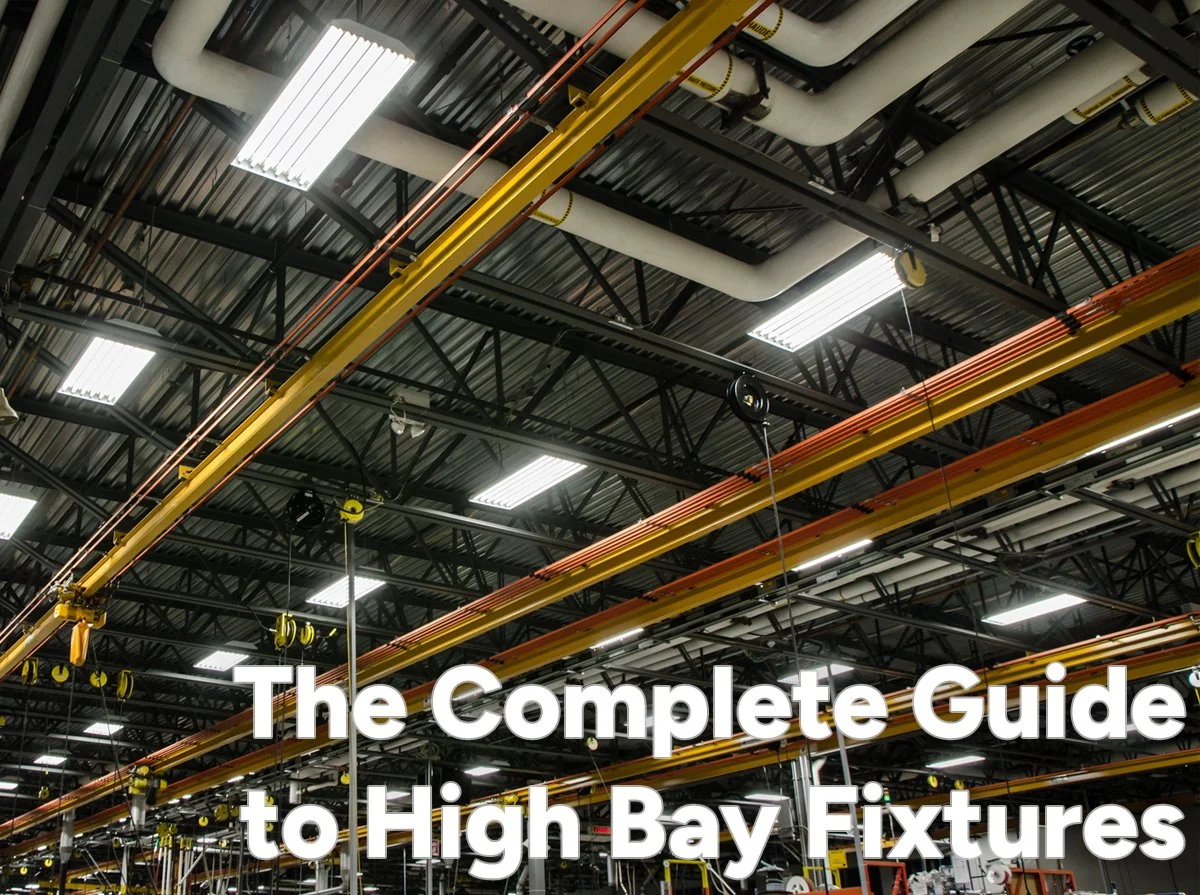
The Complete Guide to High Bay Fixtures: How to Choose the Right Lighting for Large Spaces
| What This Article Covers |
|---|
High bay fixtures are commercial lighting systems engineered for ceiling heights of 20 feet or more — and choosing the wrong one creates problems that are expensive to fix from a lift 30 feet in the air. Understanding fixture type, lumen output, beam angle, mounting height, and controls compatibility upfront is what separates a well-lit, efficient facility from one that quietly costs money every day. This guide covers the difference between UFO and linear high bay fixtures, how to calculate lumen and footcandle needs for your specific application, how mounting height affects fixture performance, when to retrofit versus fully replace existing systems, and how LED high bays compare to metal halide and fluorescent in real energy and maintenance savings. It also covers certification requirements, smart controls, common specification mistakes, and application-specific buying recommendations for warehouses, manufacturing facilities, gymnasiums, retail spaces, and churches. Best for: warehouse managers, facility managers, lighting contractors, commercial electricians, industrial operators, and anyone planning an LED high bay retrofit or specifying lighting for a new large-space commercial project. |
Updated 8/6/26 by 1000Bulbs Staff
Poor lighting in large facilities creates problems that compound quietly over time. Workers strain to read labels in dim aisles. Maintenance teams spend money replacing failing metal halide lamps from lifts 30 feet in the air.
Energy bills climb while fixture output steadily declines. In warehouses, factories, gymnasiums, and large commercial buildings, lighting is operational infrastructure, not a cosmetic decision.
High bay fixtures exist specifically to solve those problems.
The challenge is that many commercial buyers approach high bay lighting with incomplete information. Fixture shape, lumen output, beam angle, mounting height, spacing, controls compatibility, and rebate eligibility all affect long-term performance. Choosing incorrectly can create years of avoidable maintenance and visibility issues.
This guide explains how to choose the right high bay fixtures for large commercial spaces, how LED upgrades compare to older metal halide systems, and how to avoid the specification mistakes that cost facilities the most over time.
What Is a High Bay Fixture?
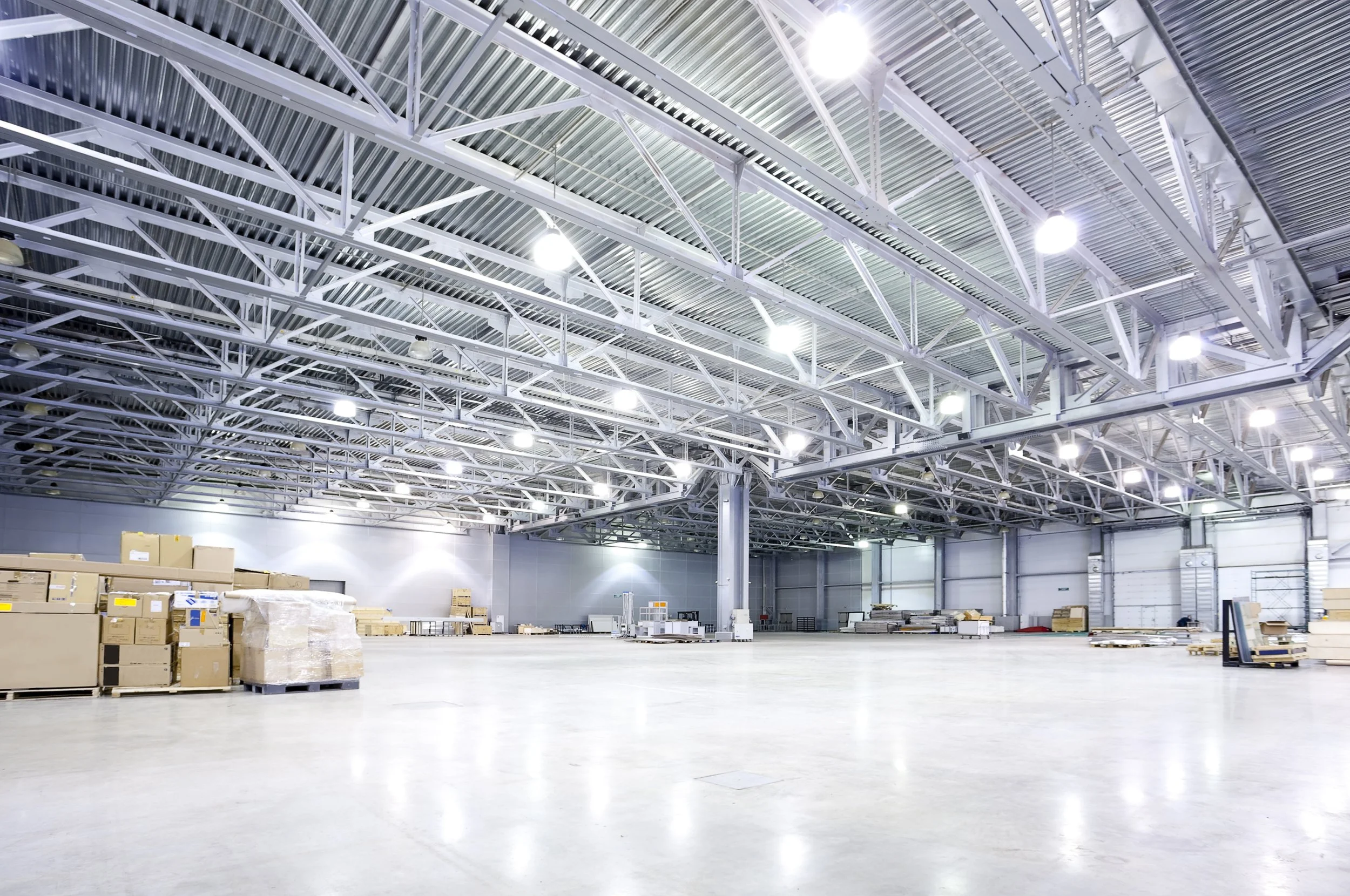
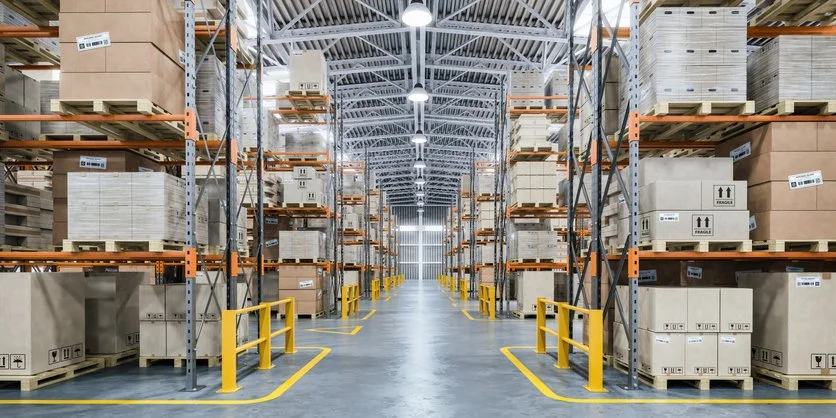
A high bay fixture is a commercial or industrial lighting system designed for spaces with ceiling heights of 20 feet or higher.
At those heights, standard commercial fixtures lose effectiveness because they cannot project enough usable light to the floor without creating dim zones or poor uniformity. High bay fixtures solve that problem through higher lumen output, more focused beam control, and optical designs engineered specifically for long-distance light distribution.
This is what separates high bay fixtures from standard commercial lighting. They are not simply “brighter fixtures.” They are engineered differently because ceiling height dramatically changes how light behaves inside a space.
Mounting height matters more in high bay lighting than in almost any other commercial lighting application. As the distance between the fixture and the work surface increases, usable floor-level illumination decreases sharply. A fixture that performs well at 18 feet may produce inadequate visibility at 30 feet unless it was specifically designed for higher mounting positions.
High bay fixtures are commonly used in:
Warehouses and distribution centers
Manufacturing and assembly plants
Aircraft hangars
Gymnasiums and sports facilities
Churches and event spaces
Big-box retail stores
Cold storage facilities
Low bay fixtures, by contrast, are typically designed for ceiling heights between 12 and 20 feet. They use lower lumen outputs and broader beam spreads intended for shorter mounting distances.
Using a low bay fixture in a high-ceiling environment usually creates:
Poor uniformity
Dark zones
Reduced visibility
Higher long-term operating costs
When Do You Need High Bay Lighting Instead of Standard Fixtures?
The general threshold for high bay lighting begins at 20-foot ceiling heights.
Once ceilings move beyond that range, high bay fixtures usually become the correct category because they are engineered to maintain usable illumination at greater distances.
Ceiling height is the primary factor, but it is not the only one.
Large open floor plans without partitions require broad, consistent coverage across wide areas. Warehouse aisle layouts require tighter beam control that directs light downward along shelving rows instead of wasting illumination between aisles.
Task intensity also matters.
A warehouse storing bulk pallets can operate at lower footcandle levels than:
Active fulfillment centers
Assembly operations
Manufacturing facilities
Gymnasiums
Maintenance accessibility is another major consideration.
Replacing failed fixtures at 30 feet requires:
Lift equipment
Labor scheduling
Downtime coordination
LED high bay fixtures reduce those service demands dramatically because many are rated for 50,000 hours or more of operation.
High Bay vs Low Bay at a Glance
| Factor | High Bay | Low Bay |
|---|---|---|
| Ceiling height | 20 feet and above | 12 to 20 feet |
| Typical lumen output | 10,000 to 40,000+ lumens | 3,000 to 12,000 lumens |
| Beam spread | Narrower, focused downward | Wider distribution |
| Typical applications | Warehouses, factories, hangars, gyms | Retail, offices, parking structures |
| Typical LED wattage | 100W to 300W+ | 30W to 100W |
Types of High Bay Fixtures Explained
Different high bay fixture types solve different operational problems. The best choice depends on ceiling height, floor layout, aisle structure, environmental conditions, and maintenance priorities.
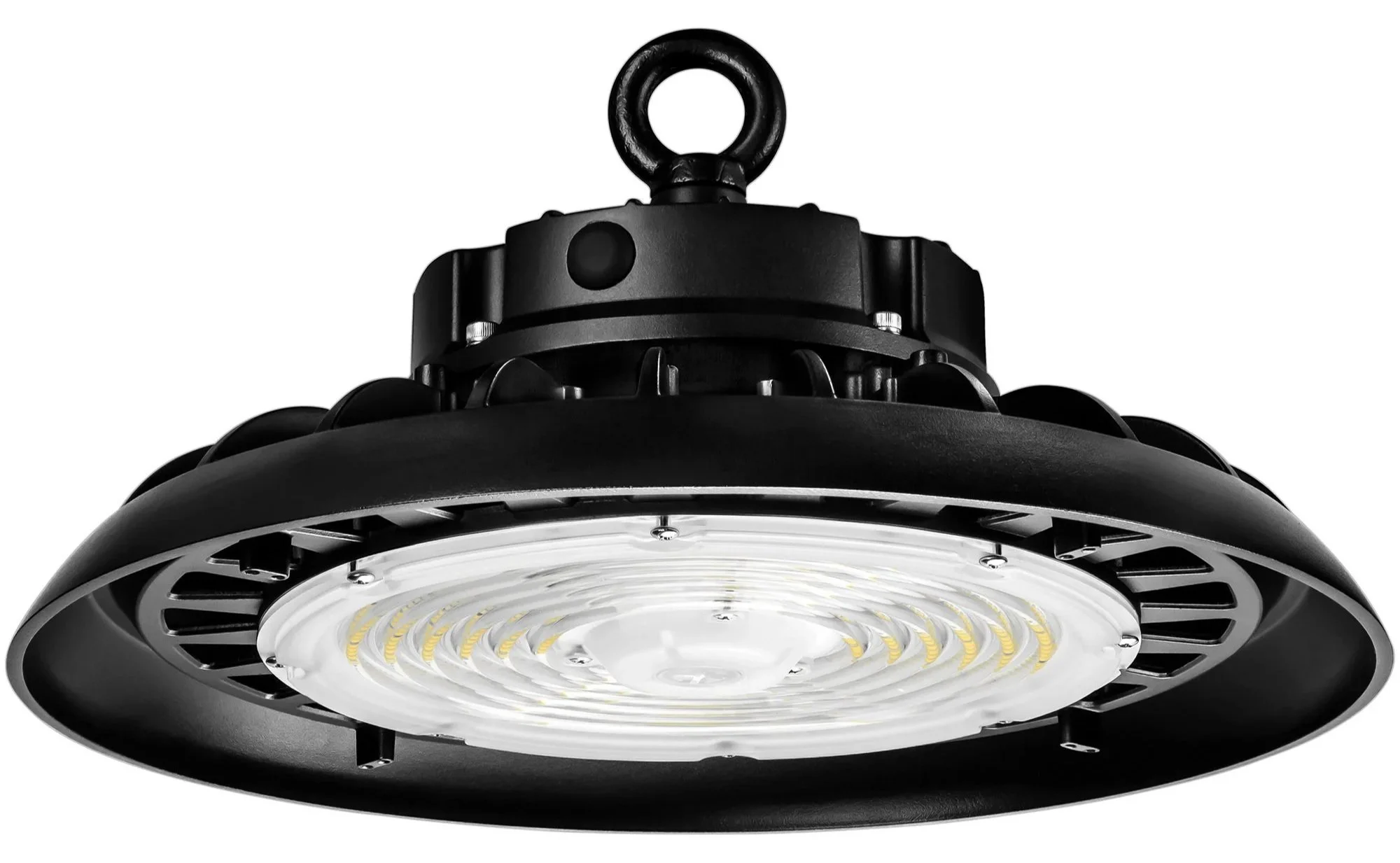
Round UFO high bay fixture without a reflector.
UFO High Bay Fixtures
UFO high bay fixtures take their name from their compact, round housing design.
Their symmetrical beam distribution makes them especially effective in:
Open warehouse floors
Manufacturing areas
Logistics facilities
Distribution centers
Because UFO fixtures distribute light in a broad circular pattern below the fixture, they work well in spaces without fixed aisle layouts or shelving rows.
Installation is also relatively simple. Most UFO fixtures use:
Hook mounts
Hardwired systems
Integrated driver construction
Many modern UFO high bay fixtures are built with die-cast aluminum housings and carry IP65 ratings for dust and moisture resistance, making them suitable for industrial environments with airborne debris or occasional moisture exposure.
Some UFO fixtures are also available with acrylic reflectors. These reflectors help redirect a portion of the light upward toward the ceiling, reducing the “cave effect” common in large industrial spaces. They also create a visual appearance that more closely resembles traditional HID high bay fixtures, which some facilities prefer during retrofit projects.
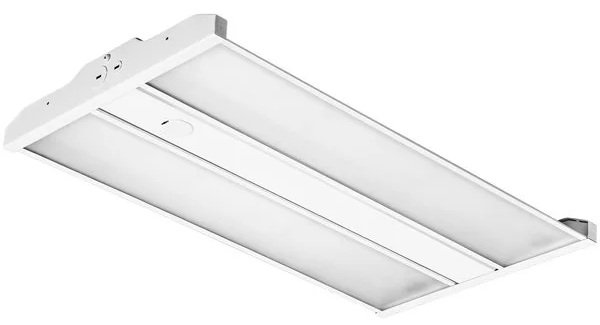
Linear LED high bay
Linear High Bay Fixtures
Linear high bay fixtures use a rectangular housing that distributes light in an elongated pattern rather than a circular one.
That lateral light spread makes linear fixtures especially effective in:
Warehouse aisles
Retail spaces
Gymnasiums
Grocery stores
Structured shelving environments
In aisle-based layouts, linear fixtures distribute illumination more effectively along shelving rows than UFO fixtures, which can leave gaps between aisles if spacing is not carefully planned.
Linear fixtures also create a cleaner commercial appearance in customer-facing environments. Many include diffused lens options that reduce harsh glare while maintaining consistent floor-level brightness throughout the space.
Vapor-Tight and Harsh Environment Fixtures
Some facilities require lighting systems that can withstand moisture, chemical exposure, washdown conditions, or airborne contaminants.
Vapor-tight high bay fixtures use:
Sealed housings
Gasketed enclosures
Polycarbonate lenses
These fixtures are commonly used in:
Food processing facilities
Cold storage warehouses
Agricultural buildings
Chemical storage areas
Industrial washdown environments
For harsh commercial conditions, facilities commonly look for:
IP65 ratings
IP66 ratings
NSF-listed fixtures for food-safe environments
Standard high bay fixtures may fail prematurely in these environments if they are not properly rated for exposure conditions.
How Many Lumens Do High Bay Fixtures Need?
One of the most common mistakes in commercial lighting is choosing high bay fixtures based only on wattage.
Wattage measures energy consumption, not usable brightness. Two fixtures using the same wattage can produce dramatically different lumen output depending on optical efficiency, driver quality, and fixture design.
For high bay lighting, lumen output and beam distribution matter far more than wattage alone.
Understanding Lumen Requirements
The amount of light a facility needs depends on:
Ceiling height
Task visibility requirements
Aisle layout
Surface reflectivity
Fixture spacing
Uniformity goals
A warehouse storing bulk inventory may require lower illumination levels than:
Precision assembly areas
Fulfillment operations
Gymnasiums
Manufacturing facilities
As a general reference:
Lower-end high bay fixtures may produce around 10,000 lumens
Mid-range commercial fixtures often operate between 15,000 and 25,000 lumens
Large industrial high bay fixtures can exceed 40,000 lumens
The correct fixture is not necessarily the brightest option. The goal is to achieve proper floor-level illumination and uniformity without creating excessive glare or wasted light.
Typical Footcandle Targets
Most commercial lighting plans calculate brightness using footcandles, which measure how much light reaches the working surface.
Typical recommendations include:
| Facility type | Typical footcandle range |
|---|---|
| Bulk warehouse storage | 10 to 20 fc |
| Warehouse picking aisles | 20 to 40 fc |
| Manufacturing and assembly | 30 to 50 fc |
| Gymnasiums | 30 to 75 fc |
| Retail warehouse spaces | 50 fc and above |
Facilities handling detailed visual tasks often require higher illumination levels and tighter uniformity ratios than general storage environments.
Why Beam Angle Matters
Beam angle changes how light spreads throughout the space.
Wide beam distributions work well in open-floor environments where broad coverage is the priority, such as:
90-degree
120-degree optics
Also, Narrower beam angles closer to 60 degrees perform better in tall warehouse aisles and concentrated work areas because they direct more usable light downward instead of spilling illumination into adjacent spaces.
A fixture producing extremely high lumen output can still perform poorly if the beam distribution does not match the layout of the facility.
LED High Bay Fixtures vs Metal Halide and Fluorescent
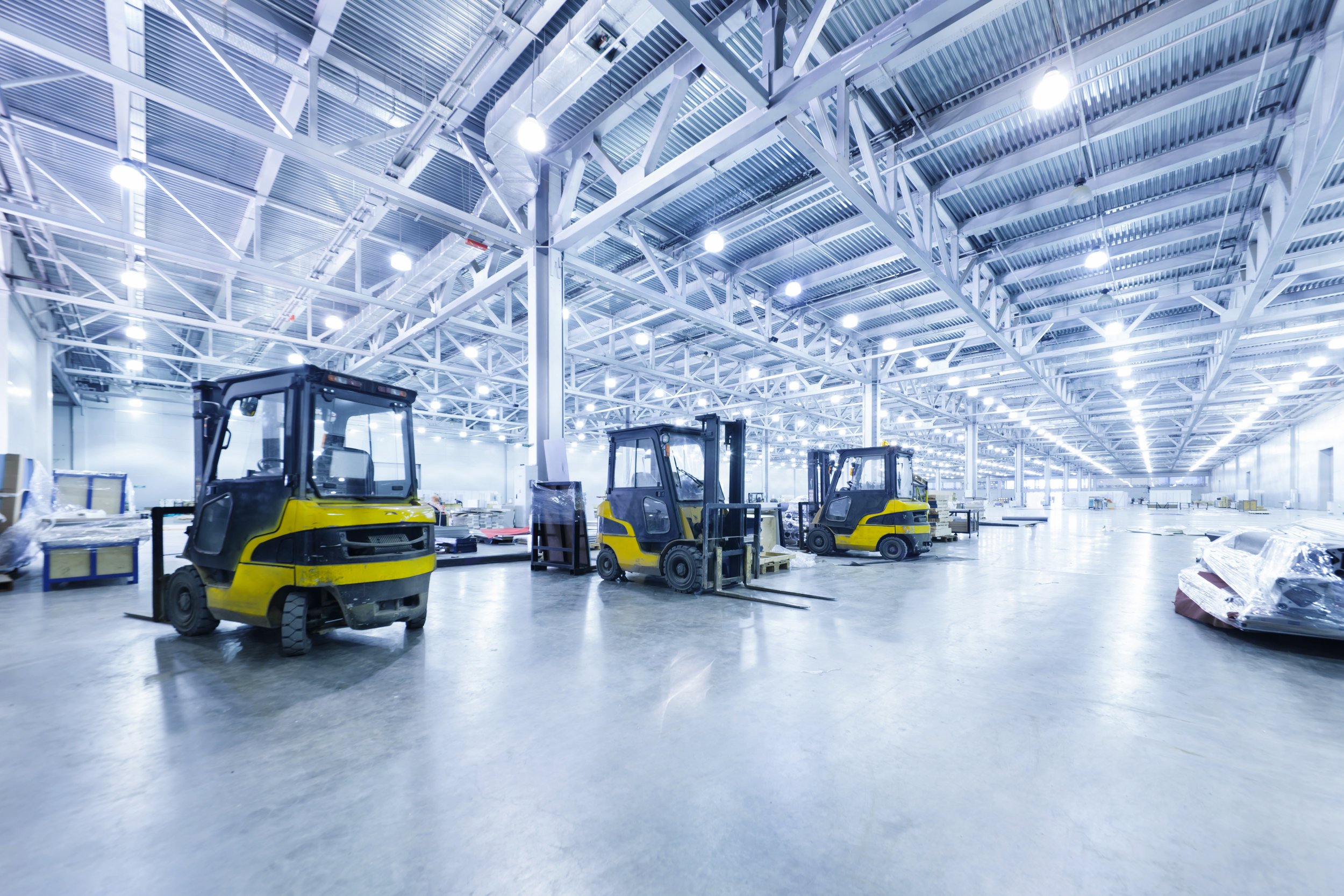
Metal halide and fluorescent systems dominated commercial high bay lighting for decades. Many facilities still operate those systems today because the fixtures technically continue functioning.
The issue is that older lighting technologies become increasingly inefficient and maintenance-heavy over time.
LED high bay fixtures address many of the operational problems associated with:
Metal halide systems
Energy Efficiency Differences
Traditional metal halide high bay fixtures commonly operate between 250W and 1,000, depending on mounting height and facility size.
Modern LED high bay fixtures frequently achieve comparable or better usable illumination using 100W to 300W fixtures.
A common retrofit example involves replacing 400W metal halide fixtures with 150W to 200W LED high bays, while maintaining comparable floor-level brightness.
For facilities operating hundreds of fixtures daily, those wattage reductions create substantial long-term utility savings.
Maintenance Reduction
Maintenance becomes one of the highest hidden costs in high bay lighting systems.
Replacing fixtures at:
25-foot
30-foot
40-foot mounting heights
Metal halide systems also experience progressive lumen degradation. Even before lamps fail entirely, fixture output declines significantly over time, creating dimmer facilities without operators immediately realizing it.
LED high bay fixtures dramatically reduce those maintenance demands because many are rated for 50,000 to 100,000 hours, depending on driver quality and operating conditions.
That longer lifespan helps facilities reduce:
Lift rentals
Lamp replacement inventory
Maintenance labor
Operational downtime
Startup Speed and Controls Compatibility
Metal halide fixtures require warm-up and restrike periods after shutdowns or power interruptions. In many facilities, those delays can last 15 to 20 minutes before fixtures return to full brightness.
LED high bay fixtures restore full output instantly.
That immediate startup also makes LEDs compatible with:
Occupancy sensors
Motion controls
Scheduled dimming
Smart lighting automation
Color Rendering and Visibility
LED high bays also improve visual clarity through better color rendering and more consistent output.
Many fluorescent and HID systems produce uneven color temperatures as lamps age. LED fixtures maintain more stable:
Color temperature
Brightness levels
Optical performance
High-CRI LED fixtures become especially valuable in:
Manufacturing facilities
Fulfillment centers
Retail warehouse spaces
Sports facilities
How Fixture Spacing Affects High Bay Performance
Fixture spacing has just as much impact on lighting quality as lumen output.
Even powerful fixtures, if spacing is poorly planned, can create:
Dark zones
Glare
Uneven illumination
High bay layouts should always account for:
Mounting height
Beam angle
Facility layout
Racking systems
Surface reflectivity
Target footcandle levels
Mounting Height and Spacing Relationship
As mounting height increases, fixtures can generally be spaced farther apart.
However, excessive spacing often creates visible brightness gaps between fixtures, especially in warehouse aisles and manufacturing spaces where uniformity matters.
A fixture mounted at 35 feet requires substantially different spacing than the same fixture mounted at 20 feet
This is because the light spreads over a much larger area before reaching the floor.
Open Floor Plans vs Aisle Layouts
Open warehouse floors and gymnasiums typically allow broader fixture spacing because the lighting distribution remains relatively unobstructed.
Warehouse aisle systems create more complex lighting challenges because shelving blocks and absorbs light before it reaches lower rack levels.
Facilities often require narrower optics or supplemental aisle-focused lighting to maintain proper visibility throughout the facility, such as:
Tall storage systems
Narrow aisles
Dense shelving layouts
Why Photometric Planning Matters
Photometric lighting plans model:
Fixture spacing
Beam spread
Footcandle levels
Uniformity ratios
Without photometric analysis, facilities often end up:
Over-lighting spaces and wasting energy
Or under-lighting critical work areas
Both problems become expensive to correct after installation is complete.
For larger commercial projects, photometric planning is one of the most valuable steps in the specification process because it confirms how the lighting system will actually perform inside the real environment instead of relying only on fixture spec sheets.
Smart Controls and Motion Sensors for High Bay Lighting
Lighting controls are one of the fastest ways large facilities can reduce operating costs without sacrificing visibility.
Many warehouses, manufacturing spaces, and gymnasiums do not require full light output across every area at all times. Smart controls allow high bay fixtures to respond dynamically to occupancy patterns, daylight availability, and operating schedules instead of operating at maximum output continuously.
Occupancy Sensors
Occupancy sensors automatically dim or switch off fixtures when areas become inactive.
This strategy works especially well in:
Warehouse aisles
Storage zones
Secondary manufacturing areas
Maintenance spaces
Cold storage facilities
For example, a distribution center may have picking aisles that remain inactive for extended periods between workflow cycles. Sensor-controlled LED high bays can reduce output during those inactive periods and restore full brightness within seconds once movement resumes.
Facilities using occupancy-based dimming commonly reduce lighting energy consumption in controlled zones by 30 to 50 percent, depending on traffic patterns and operating schedules.
Daylight Harvesting
Large commercial buildings with skylights or clerestory windows can also reduce artificial lighting usage through daylight harvesting controls.
Photosensors measure available natural light and automatically dim fixtures when sunlight provides sufficient illumination throughout the facility.
This strategy works particularly well in:
Distribution centers
Manufacturing facilities
Retail warehouse spaces
Gymnasiums with natural daylight exposure
Instead of operating fixtures at full brightness throughout the day, daylight harvesting systems continuously adjust output levels to maintain more consistent illumination while reducing energy consumption.
Scheduled Dimming
Facilities operating multiple shifts can also lower operating costs through scheduled dimming strategies.
Lighting systems can automatically reduce output during:
Overnight maintenance periods
Break windows
Partial shutdowns
Low-traffic operating hours
Many facilities also create zone-based lighting schedules that prioritize active work areas while reducing output in less frequently used sections of the building.
Networked Lighting Systems
Modern networked lighting controls give facility managers significantly more operational visibility than traditional standalone systems.
Networked systems can allow operators to:
Monitor fixture performance
Track energy usage
Receive outage alerts
Adjust dimming schedules remotely
Group fixtures into lighting zones
For large facilities operating hundreds of fixtures, remote monitoring can simplify maintenance planning and help identify failing drivers or control issues before they affect large portions of the building.
Most commercial LED high bay fixtures already support:
0-10V dimming
Motion sensor integration
Smart control compatibility
Retrofit Kits vs Full Fixture Replacement
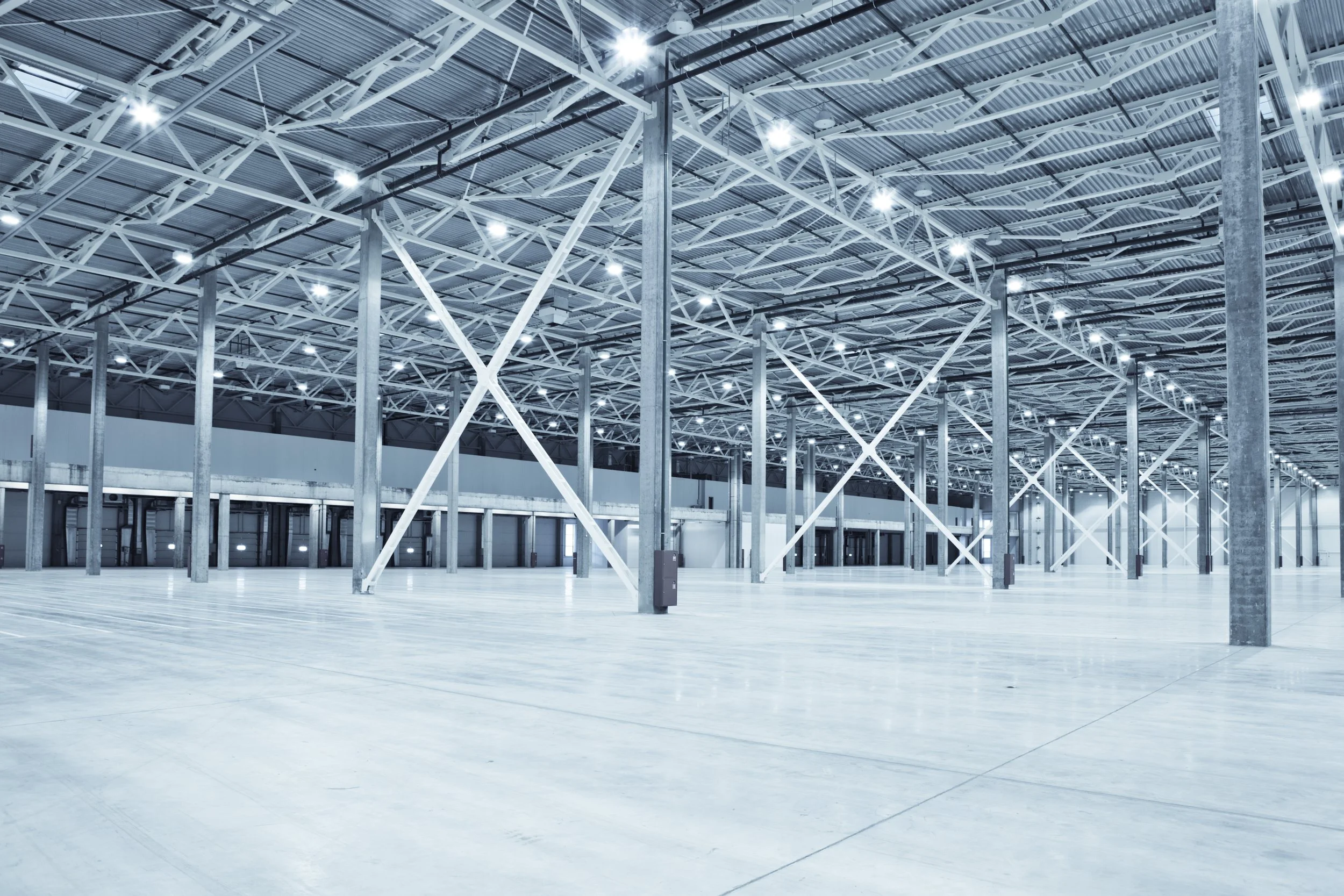
Not every high bay lighting upgrade requires replacing the entire fixture. In many facilities, LED retrofit lamps provide a faster, lower-cost way to convert existing HID high bay fixtures to LED technology while keeping the original housing in place. In other situations, replacing the complete fixture offers better long-term performance, improved optics, and access to modern controls. The best option depends on the condition of the existing fixtures, project budget, maintenance goals, and desired lighting performance.
LED Retrofit Lamps
LED retrofit lamps are designed to replace metal halide or high-pressure sodium lamps inside compatible existing high bay fixtures. Instead of removing the entire fixture, facilities replace only the light source, making retrofit lamps an attractive option when the housing remains in good condition.
Lighting Tip: The most common LED retrofit lamps for UFO high bays include LED corn bulbs, LED filament retrofit bulbs, and LED high bay and low bay retrofit lamps.
Retrofit lamps can help reduce project costs because they often:
Reuse the existing fixture housing
Require less installation labor than full fixture replacement
Minimize disruption to facility operations
Deliver significant energy savings compared to HID lighting
However, retrofit lamps also inherit some limitations of the original fixture, including older reflector designs, reduced optical performance, and limited compatibility with advanced controls. If the existing housing is deteriorating or the facility requires improved light distribution, replacing the entire fixture is often the better long-term investment.
Full Fixture Replacement
Complete fixture replacement generally provides the best long-term performance for large commercial environments.
Modern LED high bay fixtures offer:
Improved optical control
Better thermal management
Higher efficiency
Cleaner installation appearance
Integrated controls compatibility
Full replacement often makes the most sense when:
Existing fixtures are heavily degraded
Ceiling access is already available
Smart controls are planned
Maintenance issues are ongoing
Facility layouts have changed
Many facilities also choose full replacement because it improves lighting consistency throughout the building instead of simply converting the existing fixture to LED operation.
Cost vs Long-Term Value
LED retrofit lamps typically have a lower upfront cost because much of the existing fixture remains in place. Full fixture replacement generally requires a larger initial investment but provides new optics, improved thermal management, integrated drivers, and compatibility with occupancy sensors, daylight harvesting, and networked lighting controls.
Facilities planning to remain in the building for many years often find that full fixture replacement delivers the greatest lifetime value through lower maintenance costs, better lighting quality, and longer system life. For shorter-term upgrades or facilities with structurally sound housings, retrofit lamps can provide an effective and economical path to LED technology.
Rebates and ROI Considerations
Many utility providers offer incentive programs for commercial LED lighting upgrades.
These rebate programs commonly prioritize:
LED high bay retrofits
DLC-listed fixtures
Occupancy sensor integration
Energy-efficient lighting controls
For large facilities operating hundreds of fixtures, rebates can significantly improve project payback timelines.
DLC Certification
DLC-listed fixtures are commonly required for:
Utility rebate eligibility
Commercial incentive programs
Energy-efficiency projects
The DesignLights Consortium (DLC) certification process verifies:
Fixture efficiency
Lumen maintenance
Performance standards
Product reliability
Facilities planning commercial retrofit projects should confirm DLC eligibility before finalizing fixture selection.
Typical LED Retrofit Payback Periods
Most LED high bay retrofits recover their installed cost within roughly 2 to 5 years, depending on:
Operating schedules
Utility rates
Existing fixture type
Maintenance costs
Fixture quantity
Control integration
Facilities operating older metal halide systems on long daily schedules usually experience the fastest return on investment because those systems consume substantial energy and require ongoing maintenance.
Maintenance Savings Matter Too
Many facilities calculate ROI using only energy savings while overlooking maintenance reduction.
In high-ceiling environments, every avoided fixture replacement reduces:
Lift equipment usage
Maintenance labor
Operational downtime
Replacement lamp inventory
Over the lifespan of the system, maintenance reduction often becomes just as valuable as electrical savings.
Choosing the Right High Bay Fixture Matters Long After Installation
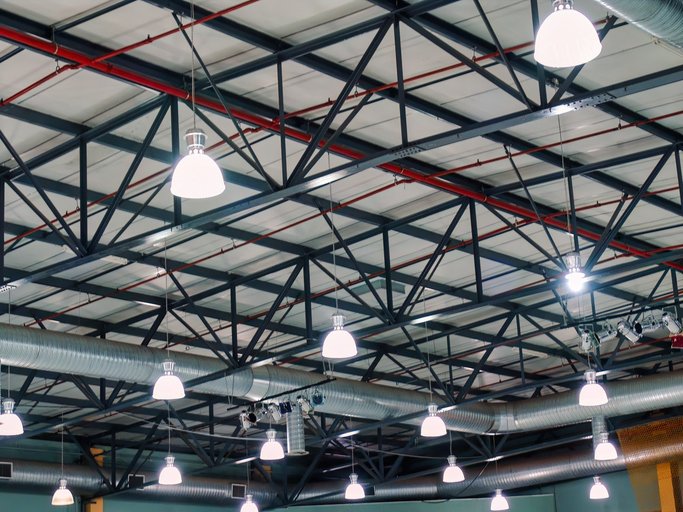
High bay lighting decisions affect facility operations for years after the fixtures are installed.
The right system improves:
Visibility
Safety
Energy efficiency
Maintenance planning
Employee comfort
Operational consistency
The wrong system creates ongoing problems through uneven illumination, excessive maintenance demands, poor uniformity, and unnecessary operating costs.
Modern LED high bay fixtures have become the standard for large commercial spaces because they combine:
Lower energy consumption
Longer lifespan
Better optical control
Faster startup
Smart controls compatibility
Whether you are planning a warehouse retrofit, upgrading a manufacturing facility, lighting a gymnasium, or evaluating fixture options for a new construction project, choosing the correct fixture type, lumen package, beam angle, and controls strategy up front helps avoid costly corrections later.
1000Bulbs carries a wide selection of commercial LED high bay fixtures, retrofit kits, linear high bays, UFO fixtures, and industrial lighting solutions designed for large commercial spaces.
To speak with a US-based lighting specialist, call 1-800-624-4488 Monday through Friday from 7 a.m. to 7 p.m. CST.
FAQs
What Ceiling Height Requires High Bay Lighting?
High bay fixtures are generally recommended for ceiling heights of 20 feet or higher because they are designed to maintain usable illumination at longer mounting distances.
What Is the Difference Between UFO and Linear High Bay Fixtures?
UFO high bays use a circular beam pattern that works well in open spaces, while linear high bays distribute light in a rectangular pattern better suited for warehouse aisles and structured layouts.
How Many Lumens Do High Bay Lights Need?
The required lumen output depends on ceiling height, facility layout, and task visibility needs. Commercial high bay fixtures commonly range from 10,000 to more than 40,000 lumens.
Are LED High Bay Lights Better Than Metal Halide?
LED high bay fixtures generally offer lower energy consumption, longer lifespan, reduced maintenance, faster startup, and better controls compatibility than metal halide systems.
How Long Do LED High Bay Fixtures Last?
Most commercial LED high bay fixtures are rated between 50,000 and 100,000 hours, depending on fixture quality and operating conditions.
What Are Footcandles in High Bay Lighting?
Footcandles measure how much light reaches the working surface. Commercial facilities use footcandle calculations to determine appropriate brightness levels and lighting uniformity throughout the space.