
The Complete Guide to T5 Tubes
| What This Article Covers |
|---|
T5 fluorescent tubes are a widely used lighting solution in offices, warehouses, workshops, retail displays, and grow lighting systems, but replacement planning can quickly become complicated. Standard T5, T5HE (High Efficiency), and T5HO (High Output) systems look nearly identical but are designed for different performance levels, may operate at different wattages, require compatible ballasts, and are not always interchangeable. Choosing the wrong tube or assuming an LED retrofit is plug-and-play can lead to flickering, poor performance, compatibility issues, and unnecessary expense. This guide explains the differences between standard T5, T5HE, and T5HO tubes, where each is commonly used, how to identify your current system, and how to evaluate your replacement options, including fluorescent, plug-and-play LED, and ballast bypass LED. It also covers energy efficiency comparisons, common retrofit mistakes, and when a full fixture replacement may make more sense than simply replacing the tubes. Best for: Facility managers, contractors, electricians, warehouse operators, grow lighting buyers, and anyone planning a T5 replacement or LED retrofit. |
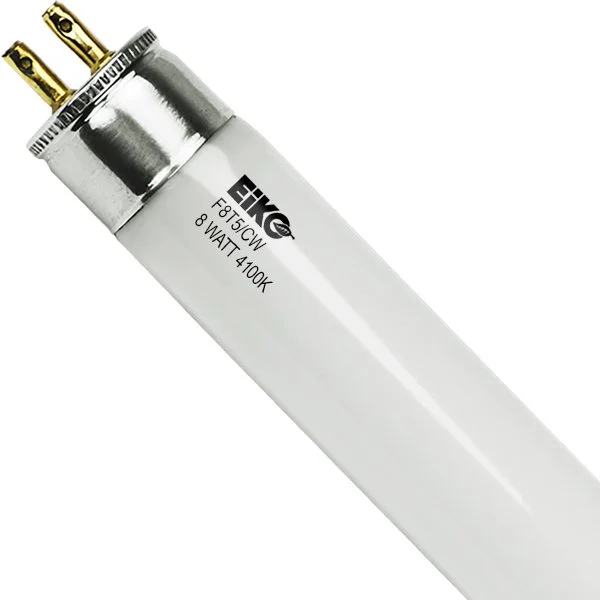
Fluorescent T5 tube
Updated 7/28/26 by 1000Bulbs Staff
T5 fluorescent tubes remain a common lighting solution in offices, warehouses, retail spaces, workshops, grow operations, and specialty fixtures where compact fluorescent systems still make practical sense. But replacement planning gets complicated quickly once ballast compatibility, the differences between standard T5, T5HE (High Efficiency), and T5HO (High Output) systems, and LED retrofit options enter the conversation.
Many facilities discover the problem only after ordering the wrong tubes. Others are trying to decide whether maintaining fluorescent systems is still worthwhile compared to upgrading to LED.
This guide explains how T5 fluorescent tubes work, the differences between standard T5, T5HE, and T5HO systems, where each is commonly used, how LED T5 replacements work, and what to verify before planning a retrofit or replacement project.
What Is a T5 Tube?
A T5 tube is a fluorescent tube light with a diameter of 5/8 inch, or approximately 16mm. The “T” designation stands for tubular, while the number 5 represents the tube diameter measured in eighths of an inch. T5 tubes are thinner than both T8 and T12 fluorescent tubes, allowing them to fit into more compact fixtures while still producing strong light output.
The T-size system is standardized across fluorescent lighting:
T5 = 5/8 inch diameter
T8 = 1 inch diameter
T12 = 1.5-inch diameter
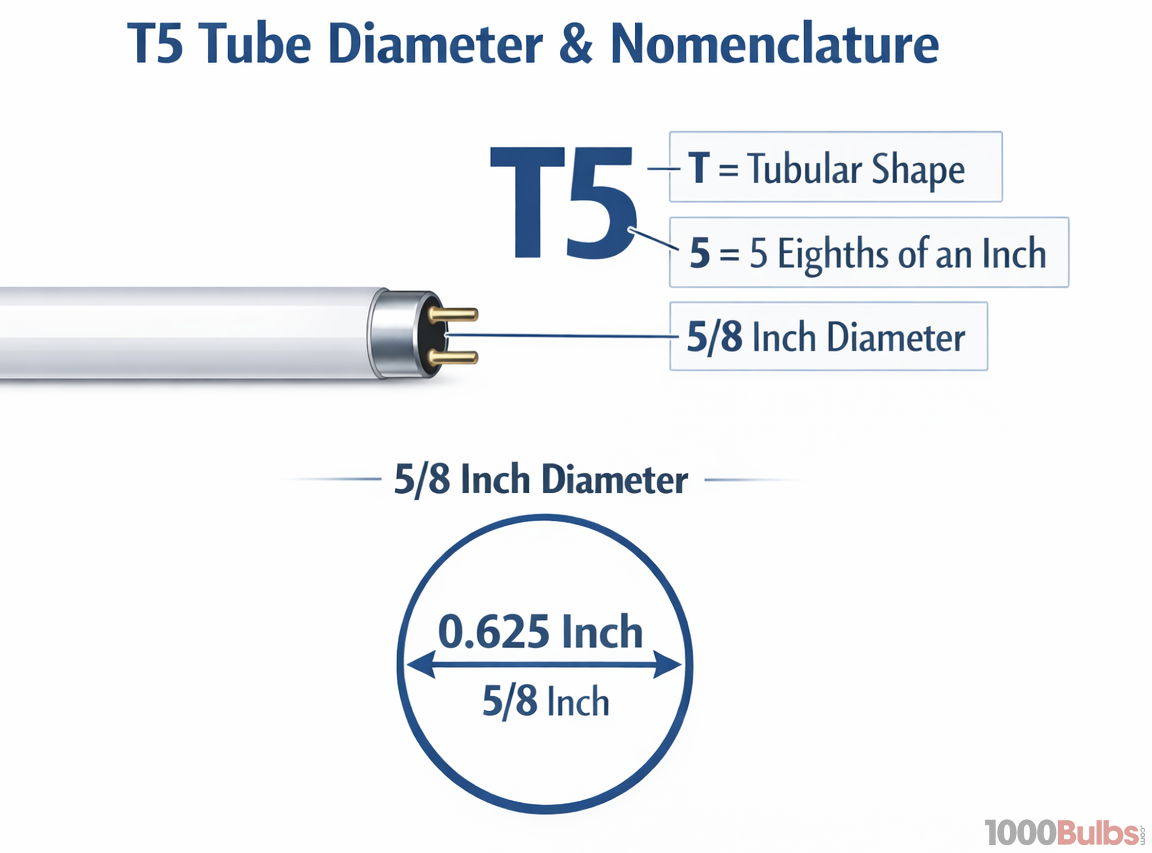
Because T5 tubes are physically smaller, manufacturers were able to design slimmer and lighter fixtures compared to older fluorescent systems. That compact design made T5 lighting especially popular in applications where fixture size, appearance, or space limitations mattered.
T5 systems became widely used in:
Offices
Under-cabinet lighting
Retail displays
Workshops
Educational facilities
Specialty fixtures
Grow lighting systems
T5 tubes use a miniature bi-pin base called a G5 base with 5mm pin spacing. This base is physically smaller than the medium bi-pin base used on T8 and T12 fluorescent systems.
That means T5 tubes cannot be installed into T8 or T12 fixtures. T5 fixtures are specifically designed around T5 systems and require compatible ballasts and sockets.
T5 fluorescent tubes are commonly available in three major categories:
Standard T5
T5HE (High Efficiency)
T5HO (High Output)
Although all three use the same G5 base and 5/8-inch tube diameter, they are designed for different performance levels and require compatible ballasts. Before replacing a tube or planning an LED retrofit, verify your existing lamp and ballast specifications to ensure compatibility.
T5 vs. T5HE vs. T5HO: What’s the Difference?
Standard T5, T5HE (High Efficiency), and T5HO (High Output) tubes all use the same 5/8-inch diameter and G5 miniature bi-pin base, but they are designed for different performance levels. A standard 4-foot T5 tube typically operates at 28 watts, while a comparable T5HO tube operates at 54 watts.
T5HE lamps are designed to maximize energy efficiency while providing more light output than standard T5 lamps without reaching the output levels of T5HO models. Because these lamp types are designed for different operating characteristics, they require compatible ballasts and should be matched to the fixture specifications.
This is one of the most common fluorescent replacement mistakes.
Because the tubes look nearly identical physically, many people assume they can swap freely between fixtures. They cannot.
The critical difference is the ballast and operating power.
Standard T5 systems are designed for moderate light output and higher efficiency per watt, making them a common choice for offices, display lighting, under-cabinet systems, slim commercial fixtures, and retail applications.
T5HE (High Efficiency) systems are designed to maximize energy efficiency while delivering more light output than standard T5 lamps. They are commonly used in commercial buildings, educational facilities, healthcare environments, office renovations, and other energy-efficient lighting retrofits where reducing operating costs is a priority.
| Factor | Standard T5 | T5HE | T5HO |
| Diameter | 5/8 inch | 5/8 inch | 5/8 inch |
| Typical Wattage | 28W | Lower than equivalent T5HO models | 54W |
| Light Output | Lower | Higher than standard T5, lower than T5HO | Much higher |
| Base Type | G5 | G5 | G5 |
| Ballast Requirement | Standard T5 ballast | Compatible ballast designed for T5HE systems | T5HO ballast |
| Interchangeable? | No | No | No |
T5HO systems are designed for significantly higher light output from the same compact tube size. They are commonly used in warehouses, industrial facilities, grow lighting systems, high-output commercial fixtures, and workshops where brighter illumination is required.
A T5HO fixture produces substantially more light, but it also consumes considerably more power.
The physical appearance causes confusion because:
Both use the same base
Both use the same tube diameter
Both fit physically into the same socket style
However, the electrical requirements differ significantly between standard T5, T5HE, and T5HO systems. Installing a tube that is not compatible with the existing ballast can lead to startup problems, incorrect brightness, flickering, reduced lamp life, or premature failure.
Whenever possible, verify the ballast label before ordering replacement tubes to ensure the new lamps are compatible with the fixture.
Where Are T5 Tubes Commonly Used?
T5 systems became popular largely because they delivered strong fluorescent performance from compact fixtures.
That flexibility allowed T5 lighting to expand into applications where larger T8 and T12 fixtures were impractical.
Office and Commercial Lighting
Standard T5 and T5HE (High Efficiency) fixtures became a common choice for offices, conference rooms, schools, libraries, and retail environments. Their compact design worked especially well in suspended ceilings and modern architectural layouts where larger fluorescent housings were undesirable.
T5HE systems, in particular, became popular in energy-efficient commercial buildings because they provided improved efficiency while maintaining the slim profile of standard T5 fixtures.
Workshops and Garages
T5 and T5HO fixtures remain popular in workshops and garages because they provide strong task lighting with relatively compact fixture designs.
T5HO systems are especially common where higher brightness levels are needed for detailed work.
Retail and Hospitality Spaces
Retail stores, restaurants, and hospitality environments often use T5 systems for:
Display lighting
Cove lighting
Accent lighting
Under-shelf lighting
Decorative fixture applications
The smaller lamp size allows tighter fixture integration without the visual bulk associated with larger fluorescent systems.
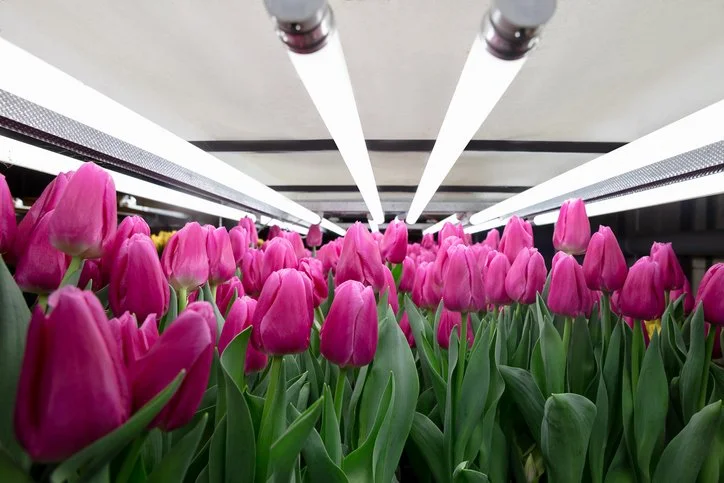
T5 grow lights are specialty bulbs designed specifically to target light ranges ideal for plant growth.
Under-Cabinet and Specialty Fixtures
T5 fluorescent systems became extremely common in under-cabinet lighting because the slim tubes fit easily into shallow fixture housings.
Many older kitchens, workstations, and commercial counters still operate T5 under-cabinet fixtures today.
T5 Fluorescent vs. T5 LED Replacements
Fluorescent T5 systems were considered highly efficient when they were introduced, especially compared to older T12 lighting. But modern LED replacements now outperform fluorescent T5 in several important areas, including energy usage, maintenance reduction, lifespan, and cold-temperature performance.
For many facilities, the decision is no longer whether LED performs better. The real question is whether the existing T5 fixtures are worth retrofitting or whether full fixture replacement makes more sense.
Fluorescent T5 Advantages
Traditional fluorescent T5 systems still offer some practical advantages in existing installations.
They provide:
Predictable light distribution
Familiar replacement processes
Lower upfront replacement cost
Compatibility with existing fluorescent infrastructure
In facilities where the fixtures and ballasts are still in good condition, replacing aging fluorescent tubes with new fluorescent lamps can still be a practical short-term maintenance strategy.
That is especially true for:
Smaller facilities
Temporary installations
Buildings nearing larger renovations
Specialty fixtures where LED retrofits are limited
Why Are Many Facilities Switching to LED?
LED T5 replacements improve on fluorescent systems in several ways.
Compared to fluorescent T5 tubes, LED replacements generally offer:
Lower energy consumption
Longer lifespan
Instant startup
No mercury
Better cold-temperature performance
Reduced maintenance frequency
The efficiency gains are meaningful, though not as dramatic as older T12-to-LED conversions.
A standard fluorescent T5 system can often reduce energy usage noticeably when converted to LED equivalents, especially when ballast losses are eliminated through ballast bypass retrofits.
Maintenance reduction is often the bigger long-term advantage.
Fluorescent T5 systems eventually require:
Tube replacement
Ballast replacement
Disposal handling for mercury-containing lamps
LED retrofits reduce or eliminate many of those recurring maintenance requirements.
For facilities with high ceilings, difficult fixture access, or large fixture counts, reduced relamping frequency can significantly lower maintenance labor costs over time.
Fluorescent Phase-Outs May Affect Your Replacement Options
In recent years, several states have adopted regulations that restrict or phase out the sale of many fluorescent lamps as part of broader energy efficiency and mercury reduction initiatives. While requirements vary by state, these regulations are accelerating the transition from fluorescent lighting to LED technology.
If you're replacing T5 fluorescent tubes, it's worth confirming that the products you plan to purchase are still available and permitted in your area. Even where fluorescent lamps remain available, manufacturers continue to shift production toward LED alternatives, making fluorescent replacements more difficult to source over time.
For many facility managers, converting to LED is no longer just an energy-saving upgrade. It is also a proactive way to prepare for changing regulations, simplify future maintenance, and ensure replacement lamps remain readily available.
T5 Fluorescent vs. LED Comparison
| Factor | Fluorescent T5 | LED T5 Replacement |
| Energy efficiency | Good for fluorescent technology | Higher |
| Lifespan | Shorter | Much longer |
| Ballast required | Yes | Sometimes |
| Mercury content | Yes | No |
| Cold temperature performance | Reduced | Stable |
| Startup behavior | Warm-up possible | Instant-on |
| Maintenance frequency | Higher | Lower |
Are T5 LED Tubes Interchangeable With Fluorescent T5 Tubes?
T5 LED tubes can replace fluorescent T5 tubes, but compatibility depends on both the LED tube type and the existing ballast configuration. Physical fit alone does not guarantee electrical compatibility.
This is another area where many retrofit mistakes happen.
All T5 LED tubes use the same G5 miniature bi-pin base as fluorescent T5 tubes, so they physically fit into T5 sockets.
That does not automatically mean the fixture will operate correctly.
There are several types of LED T5 retrofit systems, and each handles ballast compatibility differently.
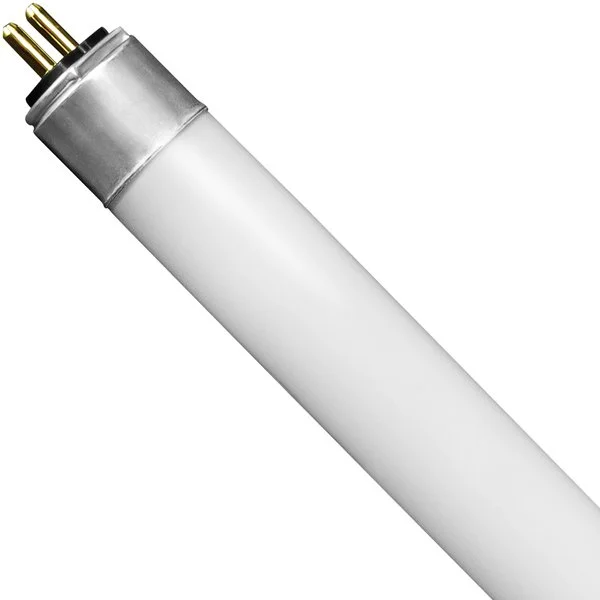
LED T5 tube
Plug-And-Play LED T5 Tubes
Plug-and-play LED tubes, also called Type A LED tubes, operate using the existing fluorescent ballast.
Installation is simple:
Remove the fluorescent tube
Install the LED tube
No rewiring is required if the ballast is compatible.
However, not all electronic T5 ballasts are compatible with every plug-and-play LED tube.
Before purchasing Type A LED T5 replacements, always verify that the ballast appears on the LED manufacturer’s compatibility list.
Installing incompatible tubes may result in:
Flickering
Reduced brightness
Startup failures
Premature failure
Ballast Bypass LED T5 Tubes
Ballast bypass LED tubes, also called Type B LED tubes, eliminate the fluorescent ballast entirely.
During installation:
The ballast is disconnected or removed
The fixture is rewired
The LED tube operates directly from line voltage
This retrofit path requires electrical work and should be handled by a qualified electrician.
Ballast bypass systems are popular because they:
Eliminate ballast failures
Reduce energy losses
Improve long-term efficiency
Simplify future maintenance
For larger facilities planning long-term LED operation, ballast bypass retrofits often provide better long-term value than maintaining aging fluorescent ballasts.
Hybrid LED T5 Tubes
Some LED T5 products support both:
Plug-and-play operation
Ballast bypass operation
These hybrid systems provide more installation flexibility but usually cost more than single-mode LED tubes.
How To Identify Your Current T5 Setup
Before ordering replacement tubes, it is important to determine whether the existing system uses:
Standard T5
T5HO
T5HE
The ballast type matters just as much as the tube itself.
Check the Tube Markings
Most T5 fluorescent tubes include identifying information printed directly on the glass, making it easier to determine which type of replacement you need. Common markings include F28T5 for a standard T5 lamp, F28T5HE (or a manufacturer-specific T5HE designation) for a high-efficiency T5 lamp, and F54T5HO for a T5 high-output lamp. If you're unsure, check the fixture documentation or ballast label to confirm compatibility before ordering replacements.
Check the Ballast Label
The ballast label inside the fixture is often the most reliable way to identify the correct replacement lamp. It typically specifies the compatible tube type, wattage, lamp quantity, and operating configuration.
Always match the replacement tube to the ballast specifications, as standard T5, T5HE (High Efficiency), and T5HO (High Output) systems are designed to operate with compatible ballasts.
Use the Application as a Clue
Application type can sometimes help narrow down the system type.
For example:
Warehouses are often T5HO
Offices and under-cabinet systems are often standard T5
This is not definitive, but it can help guide the inspection process before purchasing replacements.
When in Doubt, Verify Before Ordering
Because T5, T5HE, AND T5HO tubes physically resemble each other, guessing often leads to compatibility mistakes.
If there is uncertainty after checking the tubes and ballast, consult a lighting professional before ordering replacement products.
Energy Efficiency and Operating Costs
Compared to older fluorescent technologies, T5 systems are relatively efficient. But LED replacements still reduce both energy usage and maintenance requirements enough to make retrofits attractive for many commercial facilities.
The biggest cost differences usually come from three areas:
Lamp wattage
Ballast losses
Maintenance frequency
Standard T5 fluorescent systems consume the least power because they are designed for moderate light output. T5HE (High Efficiency) systems are engineered to improve energy efficiency while delivering more light than standard T5 lamps. T5HO (High Output) systems produce the greatest light output but also operate at higher wattages to support demanding applications.
LED T5 replacements reduce energy usage further because they produce similar light output with lower wattage demand.
Ballast bypass LED systems can improve efficiency even more because the fluorescent ballast no longer consumes power during operation.
Maintenance costs also shift dramatically over time.
Fluorescent systems eventually require:
Tube replacement
Ballast replacement
Disposal handling for mercury-containing lamps
LED systems greatly extend replacement intervals, which is especially valuable in:
Warehouses
High-bay facilities
Large commercial buildings
Difficult-access installations
In many facilities, the long-term maintenance savings become just as important as the electrical savings themselves.

Replacement and Retrofit Considerations
Before planning a T5 retrofit, it is important to evaluate more than just the tubes themselves.
Fixture condition, ballast age, dimming requirements, and long-term maintenance goals all affect whether a simple tube replacement or a larger retrofit makes more sense.
Ballast Compatibility Matters First
If staying with fluorescent T5 systems, replacement tubes must match the ballast type exactly.
If converting to LED:
Plug-and-play LED tubes require compatible ballasts
Ballast bypass LED tubes require rewiring
Always verify ballast compatibility before purchasing retrofit products.
Older Fixtures May Not Justify Retrofit Investment
Some older T5 fixtures may already have:
Aging ballasts
Yellowed lenses
Worn sockets
Cosmetic deterioration
In those situations, retrofitting old fixtures may not provide the best long-term value.
For facilities already planning broader lighting upgrades, full fixture replacement may make more financial sense than continuing to maintain aging fluorescent infrastructure.
Dimming Systems Require Additional Verification
Not all LED T5 replacements support dimming.
If the existing fixture uses dimming controls, verify that the LED replacement system is compatible with the dimming protocol already installed.
Otherwise, issues such as:
Flickering
Buzzing
Unstable output
Certifications and Safety Considerations
Replacement tubes and retrofit components should always carry recognized safety certifications, such as:
UL listing
ETL listing
These certifications help confirm that the products meet established electrical safety standards.
Ballast compatibility also affects safety.
Installing incompatible fluorescent or LED tubes can create:
Overheating
Startup failures
Premature component damage
Electrical hazards
Ballast bypass retrofits involve line-voltage rewiring and should follow all manufacturer instructions and local electrical codes.
Fluorescent T5 tubes also contain mercury and require proper disposal according to local hazardous waste regulations.
LED replacements contain no mercury, which simplifies disposal and environmental handling.
Common Mistakes to Avoid When Replacing T5 Tubes
Because T5, T5HE, T5HO tubes look nearly identical, many people assume they are interchangeable. They are not. Always verify ballast type before purchasing replacement tubes.
Assuming All LED Tubes Work With All Ballasts
Plug-and-play LED tubes are not universally compatible with every T5 ballast. Always check the manufacturer’s compatibility list before ordering.
Ignoring Fixture Condition
Replacing tubes in fixtures with deteriorating housings, sockets, or lenses often creates only a temporary improvement. In some cases, full fixture replacement provides better long-term value.
Poor Large-Scale Retrofit Planning
Small plug-and-play retrofits may work well in limited installations. But in large facilities, leaving hundreds of aging ballasts in operation can create ongoing maintenance problems for years afterward. For larger retrofits, ballast bypass systems often provide stronger long-term reliability.
Installing Non-Dimmable LEDs on Dimming Systems
This remains a common retrofit mistake. Always verify dimming compatibility before installing LED T5 replacements on controlled lighting systems.
How to Choose the Right T5 Replacement
The right replacement path depends on the facility’s priorities, budget, and long-term plans.
Choose Fluorescent T5 Replacements If:
The existing system is still in good condition
Minimal upfront cost is the priority
The facility plans larger upgrades later
The retrofit is temporary or short-term
Choose Plug-And-Play LED T5 Tubes If:
You want easier installation
Existing ballasts are still relatively new
You want moderate energy savings without rewiring
Minimizing installation disruption matters most
Choose Ballast Bypass LED T5 Tubes If:
Long-term efficiency is the priority
Reducing maintenance matters most
The facility operates long daily hours
Existing ballasts are aging or unreliable
Consider Full Fixture Replacement If:
Fixtures are visibly deteriorating
The facility is planning a larger modernization project
Better lighting performance or controls integration is needed
Maintenance reduction is the primary goal
For many facilities, LED now represents the strongest long-term value because it combines lower energy usage, longer lifespan, and reduced maintenance into a single upgrade path.
Choosing the Smarter Path for T5 Lighting
T5 tubes remain a widely used lighting solution across commercial facilities, workshops, specialty fixtures, and grow lighting systems. But successful replacement planning depends on understanding the differences between standard T5 and T5HO systems, verifying ballast compatibility, and evaluating whether LED retrofits make more sense long-term.
The most important thing to remember is that physical fit does not guarantee compatibility.
T5, T5HE, and T5HO systems may look nearly identical, but ballast requirements, wattage, and output characteristics are different. The same applies to LED retrofits, where ballast compatibility and rewiring requirements determine whether the system will operate correctly.
For replacement guidance, ballast compatibility questions, or help planning a larger retrofit project, 1000Bulbs lighting specialists are available Monday through Friday, 7 a.m. to 5 p.m. CST.
Call 1-800-624-4488 or browse T5 fluorescent tubes, T5HO systems, LED T5 replacements, and retrofit accessories at 1000Bulbs.com.

FAQS
What is the difference between T5, T5HE, and T5HO?
Standard T5, T5HE (High Efficiency), and T5HO (High Output) tubes all use the same 5/8-inch diameter and G5 miniature bi-pin base, but they are designed for different performance levels. Standard T5 lamps prioritize balanced efficiency and light output, T5HE lamps provide improved efficiency with higher output than standard T5, and T5HO lamps deliver the highest light output for demanding applications. Because these systems are designed for different operating characteristics, replacement tubes should always be matched to compatible ballast specifications.
Can I replace T5 fluorescent tubes with LED?
Yes. LED T5 replacements are available in plug-and-play, ballast bypass, and hybrid configurations. Hybrid tubes can operate with a compatible ballast initially and later be converted to ballast bypass operation, offering greater installation flexibility. The right option depends on your fixture and ballast setup.
Are T5, T5HE, and T5HO interchangeable?
No. Although standard T5, T5HE (High Efficiency), and T5HO (High Output) tubes share the same physical dimensions and G5 miniature bi-pin base, they are designed for different operating characteristics and require compatible ballast configurations. Before replacing a lamp, verify the ballast specifications and fixture requirements to ensure the replacement tube is compatible.
Do LED T5 replacements require a ballast?
It depends on the LED tube type. Plug-and-play LED tubes use compatible existing ballasts, while ballast bypass LED tubes eliminate the ballast entirely. Hybrid LED tubes can operate with a compatible ballast initially and later be converted to ballast bypass operation, providing greater installation flexibility.
Is T5 still efficient compared to LED?
T5 fluorescent systems are relatively efficient for fluorescent technology, but LED systems are more efficient, last longer, and require less maintenance.
How do I identify my T5 fixture?
Check both the tube markings and the ballast label inside the fixture. Standard T5 tubes are commonly labeled F28T5, while T5HO (High Output) lamps are typically labeled F54T5HO. T5HE (High Efficiency) lamps may include a T5HE designation or use manufacturer-specific markings, so the ballast label is often the most reliable way to confirm which lamp type your fixture requires.
Are T5 tubes being phased out?
. Many states have adopted regulations that restrict or phase out the sale of certain fluorescent lamps, including some T5 products. Requirements vary by state, but the overall trend is moving toward LED lighting because it is more energy efficient and contains no mercury. If you're replacing fluorescent tubes, it's a good idea to verify local requirements and consider whether an LED retrofit is the best long-term solution.
Is LED better than fluorescent T5?
For most applications, yes. LED systems generally provide lower energy usage, longer lifespan, instant startup, and lower maintenance requirements compared to fluorescent T5 lighting.