
Coastal Lighting Guide: What It Is, Why It Matters, and How Turtle-Friendly Lighting Protects Sea Turtles
| What This Article Covers |
|---|
Standard outdoor fixtures aren't built to survive salt air. This guide explains why saltwater accelerates corrosion in typical outdoor lighting, what certifications to look for, and how coastal-grade fixtures differ from standard weatherproof lighting. It also covers turtle-friendly lighting. We'll explain why artificial light disorients nesting sea turtles and hatchlings, the science behind amber, long-wavelength light, and the FWC's three rules of wildlife lighting. You'll find guidance on retrofitting existing fixtures, where coastal and turtle-friendly lighting is legally required, and how interior lighting factors into compliance. Best for: beachfront homeowners, property managers, hotel and resort operators, and anyone building or maintaining lighting within 5 to 10 miles of the coast. |
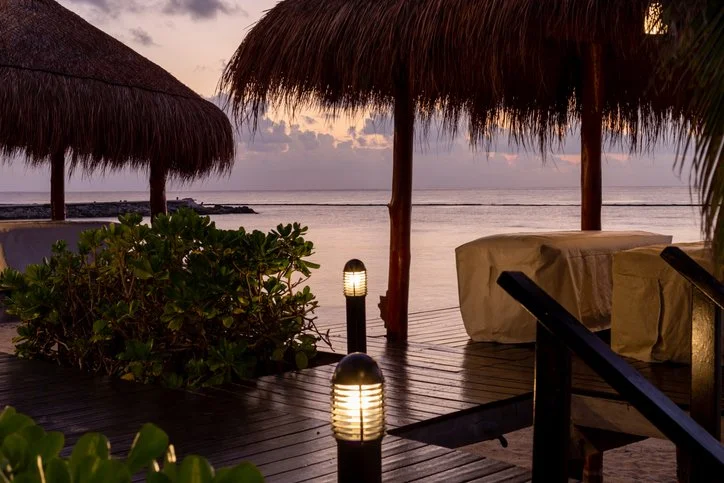
Marine-grade bollards used at a commercial beachfront property.
It's pretty common knowledge that you can't use an indoor-rated fixture outside. Why? Because the fixture isn't designed to withstand wet conditions. For outdoor applications, you use outdoor lighting. And for most general applications (landscaping, parking lots, etc), that's fine. But what happens to standard outdoor fixtures when they are used near saltwater, like at the beach?
While they may have the appropriate standard certifications, saltwater is very different from your typical rainy conditions. Mainly, it's corrosive. This means regular fixtures will corrode and rust quickly, leading to early failure. That is why you need to use coastal-grade lighting. Designed to withstand the unique conditions of saltwater environments, coastal lighting offers durable, weather-resistant solutions built for marine environments. Plus, if you live near nesting beaches, you may also be required to have turtle-friendly lighting. In this post, we’ll cover why coastal and turtle-friendly lighting matters, key features to consider, and how to choose the right products for your home or business.
What Is Coastal Lighting?
Coastal lighting covers fixtures and bulbs specifically engineered to withstand saltwater corrosion, high humidity, UV exposure, and extreme coastal weather. These corrosion-resistant outdoor lights are commonly made using UV-stable composite polymers, 316 stainless steel, solid brass, and anodized aluminium. Coastal outdoor lighting will also carry these key ratings:
UL or ETL wet locations - products rated for wet locations are designed to come into direct contact with water and weather.
IP44 for protected outdoor fixtures - IP rating indicating that the product is protected against solid objects greater than 1 millimeter (mm) in size and is protected against low-pressure water jets from any direction (using a 6.3 mm nozzle).
IP65 or higher for non-protected outdoor fixtures - IP rating that indicates the product is dust-tight and protected against low-pressure water jets from any direction. This is a common rating used for outdoor lighting fixtures.
AAMA 2605 Coating Standard - Coating rating that is the highest performance standard for exterior architectural coatings. It guarantees that metal housings and fixtures will withstand salt spray, intense sun exposure, and harsh marine environments without degrading.
Marine-grade (ASTM B117) - marine-grade outdoor lighting is designed specifically to withstand highly corrosive, moisture-rich environments. This certification is usually required for coastal areas and is also commonly used in severe-weather zones and high-humidity regions.
Beachfront homes, coastal hotels and resorts, marinas, boardwalks, and beach restaurants all require coastal lighting. Properties 5 to 10 miles inland may also require these lights, as salt air can travel farther than you would expect.
Coastal Lighting vs Weatherproof or Outdoor-Rated Lighting
Weatherproof/outdoor-rated fixtures differ from coastal outdoor lighting fixtures due to their design. Standard outdoor fixtures meet basic standards for outdoor lighting. They are protected against typical conditions, such as rain and humidity, but not against corrosion caused by salt.
Coastal lighting is designed to withstand salt and uses better components, housing, finishes, and coatings. These bulbs and fixtures also undergo rigorous testing to ensure they can withstand harsh seaside conditions and have a far longer lifespan.

Breakdown of coastal lighting vs standard outdoor lighting
Benefits of Coastal-Grade Lighting
Coastal-grade lighting provides a variety of benefits. These fixtures provide reliable performance with a longer lifespan than standard outdoor fixtures. Fixtures certified for coastal use have sealed housings that protect electrical components in high-humidity and storm conditions. The housings are also specially designed to resist rust, corrosion, and UV fading that can quickly degrade standard, non-coastal fixtures.
Their longer lifespan and better performance also reduce the need for frequent replacements, helping offset the higher upfront cost. These fixtures also maintain their aesthetics over time as they won't rust, fade, or lose their finish. They also won't leave stains behind on patios, walls, and siding. And since they have verified ratings, you can trust that they have been built to verified coastal specifications.
Where Is Coastal Lighting Required or Recommended?
Coastal lighting is required on all properties located on and near coastlines. The most well-known regulated areas include Florida, the Texas Gulf Coast, Georgia, South Carolina, North Carolina, and California. Specific regulations will vary by state, with Florida having the most established set of regulations that covers the entire state.
Coastal Lighting Fact: In Florida, all coastal and turtle-friendly lighting is controlled by the Coastal Construction Control Line (CCCL). This unique program is exclusive to Florida that strictly controls coastal developement to protect sand dunes.

Map showing areas that generally require coastal lighting.
Coastal lighting regulations apply to both commercial and residential beachfront properties. Commercial properties include hotels, resorts, restaurants, marinas, and parking structures (on or near the beach). Residential property owners include those with beachfront homes or homes near the beach (where standard outdoor fixtures would fail prematurely). Properties within 5 to 10 miles of the beach may also require coastal lighting, as saltwater can travel inland. Always check the local and state requirements to see exactly what is required.
Examples of Coastal Lighting Fixtures
Coastal lighting comes in a wide variety of fixture and bulb options. Some of the most common include bollards, retrofit lamps, area lights, LED flood light fixtures, lanterns, and LED landscape lighting. You are sure to find fixtures to match your current outdoor decor. Visit our blog to get more expert outdoor lighting design tips.
Coastal Lighting Tip: Need more ideas for finding the right landscape lighting? Check out our blog post: Landscape Lighting 101.
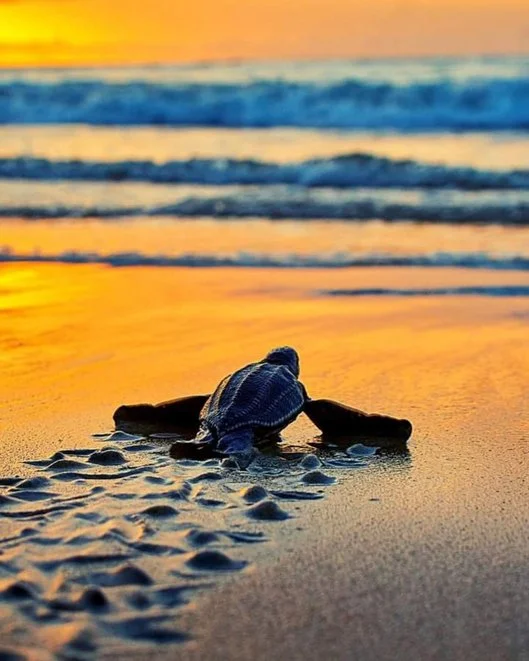
Hatchling making it's way to the ocean.
What Is Turtle-Friendly Lighting?
Turtle-friendly lights are lamps and fixtures specifically designed for coastal areas. Their main goal is to prevent sea turtles from getting disoriented by artificial lighting.
How Artificial Light Affects Sea Turtles
Artificial lights affect adult turtles and hatchlings by confusing and disrupting their natural navigational instincts. During nesting, female sea turtles seek out dark beaches. The bright blue and white colors of artificial lights can scare them away before laying eggs, resulting in fewer nests and hatchlings.
Artificial lighting can also interfere with the female's return to the ocean. After nesting, females instinctively head towards the brightest horizon. Normally, this would be moonlight and starlight reflecting off the water. Artificial light, however, appears much brighter to the sea turtles, easily drawing them further inland and away from the ocean.
Sea Turtle Fact: A "false crawl" is the term used to describe when a female sea turtle comes ashore to nest, but abandons the process.
Much like adult sea turtles, hatchlings are dependent on moonlight to navigate to the ocean. The harsh blue and white colors from artificial light disorient them, drawing them towards land and away from the water. This leaves them open to fatal predator encounters, exhaustion, dehydration, or road mortality, drastically reducing the survival rate.
Sea Turtle Fact: Between 2018 and 2023, up to 36% of hatchlings experienced diorientation due to artificial light pollution.
The Solution: Amber Light
To find a suitable solution to help sea turtles, scientists conducted multiple studies over several decades (1960s to 1990s) to answer one simple question: what color light is safe for sea turtles? They found that sea turtles can barely detect light at wavelengths of 560 nanometers (nm) or longer. Lights falling into this long-wavelength appear amber, orange, or red to humans. It allows us to see clearly while not affecting the turtles at all.
Amber light has been considered the standard for turtle-friendly lighting since the mid-1990s. Amber LED turtle lighting at the 560 nm wavelength became prevalent in 2010 and has since been widely adopted by local governments as part of their coastal lighting regulations.

This graph shows where turtle safe lighting falls on the light spectrum. It also provides additional FWC guidelines on fixtures.
The 3 Rules of Wildlife Lighting
According to the Sea Turtle Conservancy, Florida hosts almost 90% of all sea turtle nesting in the US. To help protect their nesting beaches, the Florida Fish and Wildlife Conservation Commission (FWC) and the U.S. Fish and Wildlife Service (USFWS) developed sea turtle protection guidelines that cover turtle encounters, research, and (most importantly) turtle-friendly lighting.
While these guidelines were designed specifically for Florida, many states have used them as the basis for their own turtle lighting guidelines. Most states follow FWC's recommended three rules of turtle-friendly lighting:
Keep it Low: Fixtures should be mounted as low as possible while still being appropriate for their intended purpose. Bulbs or integrated LEDs must also be low-wattage and deliver the lowest light output necessary for the task.
Keep it Long: The bulb or integrated LEDs used must be long-wavelength light sources. This means they produce an amber, orange, or red light 560nm or greater that sea turtles cannot easily see.
Keep it Shielded: Fixtures must direct all light completely downwards, with the light source or glowing lens shielded from view on the beach.
These rules eliminate unnecessary lights to reduce light pollution along beaches. They also eliminate disruptive lighting that's harmful to sea turtles and other local wildlife species.
How to Make Outdoor Lights Turtle-Friendly
Making existing outdoor light turtle-friendly can be fairly simple depending on the fixture. If you have fixtures with replaceable bulbs, you can swap the existing lamps with sea turtle-friendly LED bulbs. Common fixtures with replaceable bulbs include pathway lights, wall packs, area lights, and decorative wall sconces. Some fixtures may also have optional shields that can be added to help block unnecessary light and reduce brightness.
Certified Wildlife Lighting List
To help make it easy to find approved turtle-friendly lighting, the FWC maintains a list of all fixtures and bulbs that have passed its Wildlife Certification Program. Like DLC and other certification programs, fixtures and lamps are voluntarily submitted and evaluated against FWC guidelines.
Once approved, the manufacturer must list the specific caveats for any required accessories and where the fixture can be used, as provided by the FWC. They will also be given use of the Official Wildlife Lighting logo and have their product added to the FWC Certified wildlife lighting list. The certification is valid for 2 years after the issue date.
Interior Lights Count Too
Interior lights often get overlooked when considering turtle-safe lighting. Even though the fixtures are indoors, any interior lighting directly visible from the beach can be disruptive to adult and hatchling sea turtles. To reduce light pollution caused by interior lights:
Close blinds or window coverings at night
Turn off interior lights that aren't being used
Apply window tint to help block light
Use low-wattage, warm CCT bulbs in beach-facing rooms
Where Is Turtle-Friendly Lighting Required?
Turtle-friendly luminaires and bulbs are required in any coastal area where turtles nest. Florida is the primary regulated state, with most coastal counties and municipalities having active ordinances. These ordinances are active during sea turtle nesting season, which runs from March 1st through October 31st.
Enforcement and Penalties
Florida sea turtle lighting regulations apply to all buildings and structures seaward of the CCCL, or buildings and structures with lights visible from the beach. The FWC guides all ordinances and keeps an up-to-date certified product list. Ordinances are enforced at the county and municipal levels. Non-compliant property owners can face citations, fines, and orders to retrofit light fixtures.
Other Regulated States
Other states also require turtle-friendly lighting, including North Carolina, South Carolina, Texas, and Georgia. If you live along the coast, always check the local ordinances to find out if you need sea turtle lighting.
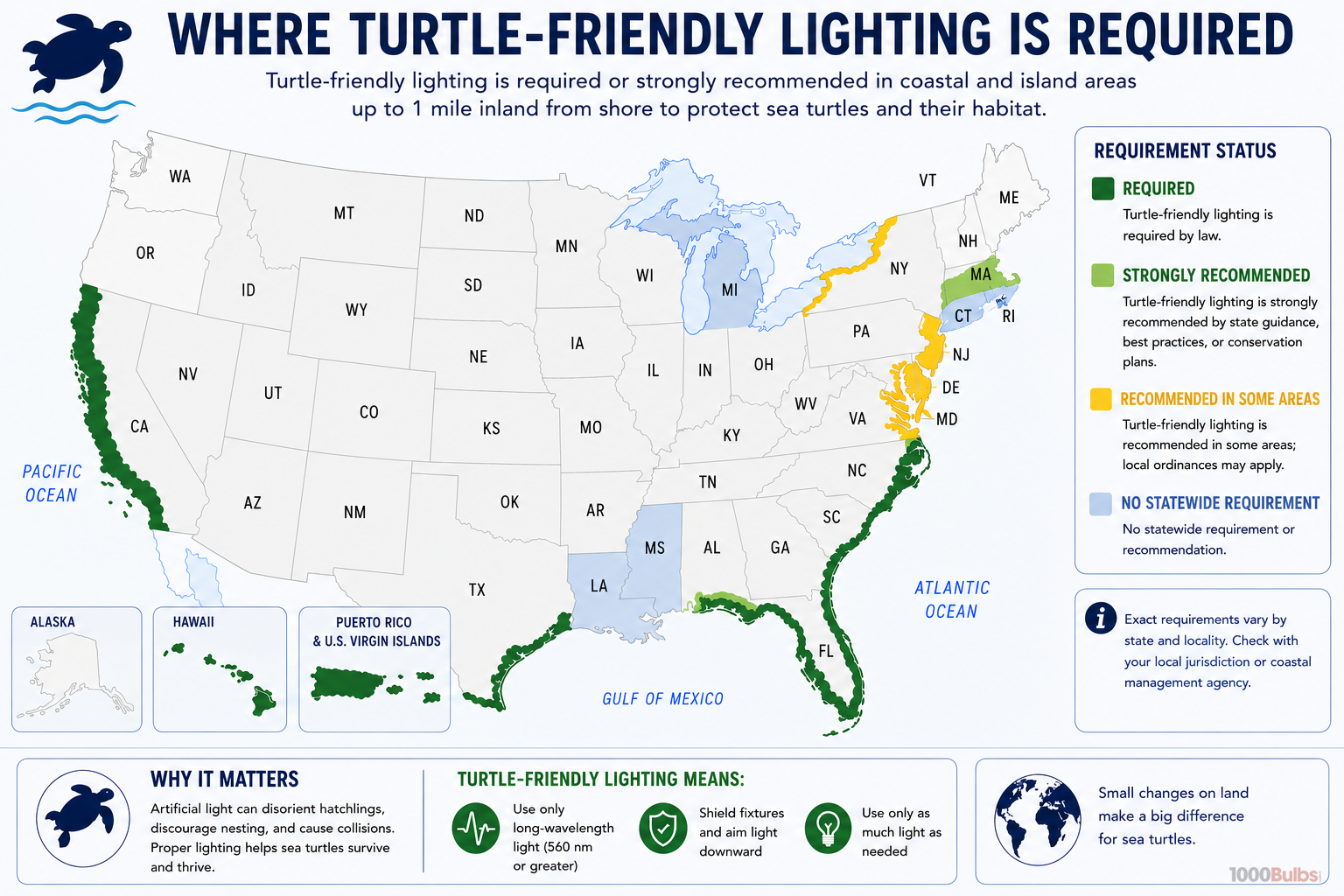
Map showing which states require, recommend, or don't require turtle-friendly lighting.
Turtle Lighting Best Practice Tip: If your coastal area doesn't have a legal mandate for turtle-friendly lighting, you should still use it. This shows care about the local ecosystem and helps protect against future regulation.
Shop Coastal Lighting at 1000Bulbs.com
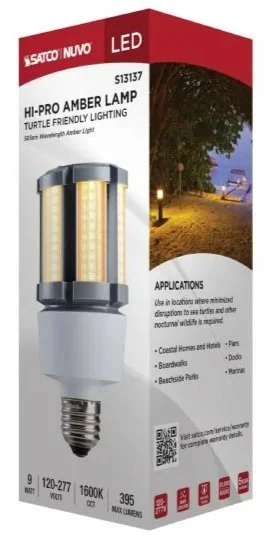
Sea turtle friendly LED bulbs from SATCO
We are excited to announce that we have started offering new turtle-friendly coastal lighting options. It has been some time since we carried turtle-safe lighting, and we are hoping to expand our offerings soon. Right now, we have amber LED corn bulbs designed to retrofit existing coastal light fixtures. They are ideal for fully enclosed fixtures such as post tops, wall packs, area lights, and more. These lamps also emit long wavelenght 585nm light, making them turtle-safe. If you have questions about coastal or turtle lighting compliance, speak with one of our lighting experts at 1-800-624-4488.
Let's recap what we've covered today. Coastal lighting is bulbs and fixtures designed to withstand salt, moisture, and other extreme coastal conditions. Turtle-friendly lights and fixtures are designed specifically to protect sea turtles from bright, disorienting lighting. Both are used in coastal regions and may be required by local or state regulations. Regardless of which type you use, both are smart investments for coastal property owners. Shop our selection of coastal lighting today!
What turtle-friendly or coastal lighting would you like us to start offering? Let us know in the comments below. And for help finding the right lighting for your home, whether for a city townhouse, apartment, or beachfront property, our lighting experts are just a phone call away at 1-800-624-4488.
FAQs
What is the difference between coastal lighting and regular outdoor lighting?
The difference between coastal and regular outdoor lighting is what they are capable of withstanding. Regular outdoor lighting is built to withstand normal weather conditions. Coastal lighting is built to withstand saltwater corrosion, high humidity, UV exposure, and extreme coastal weather.
What color light is turtle-friendly?
Amber light in long wavelengths of 560 nanometers (nm) or longer is considered turtle-friendly by the FWC and other conservation organizations. The FWC recommends using this color to protect nesting turtles and their hatchlings, as it is less disruptive than traditional white lighting.
What is the difference between turtle safe and regular lighting?
The difference between turtle-safe and regular lighting is how they affect turtles. Turtle-safe lighting consists of long-wavelength light that produces an amber light nearly invisible to sea turtles. Regular lighting, however, produces short wavelengths that can disorient sea turtles, interfering with nesting and causing them to crawl away from the ocean.
Is turtle-friendly lighting required in my state or county?
If you live near the coast, turtle-friendly lighting may be required in your state. Common states that require these lights include Florida, Georgia, South Carolina, North Carolina, Texas, and California. If you are unsure whether you are required to have coastal lighting, check your local and state laws.
Do I need turtle-friendly lighting at my beach house?
In many states, you may need to use turtle-friendly lighting at your beach house. Coastal lighting requirements vary by state, so check your local and state laws to ensure compliance.
Can I use regular LED bulbs in coastal outdoor fixtures?
You can use regular LED bulbs in coastal outdoor fixtures as long as they are rated for fully enclosed fixtures and are either damp- or wet-location rated. Also, if you are on the coastline with lights directly visible from the beach, you may need to use turtle-safe lighting. Check your local ordinances.
What does FWC-certified lighting mean?
FWC-certified lighting is the official certification for any bulb or fixture that has been tested and approved to meet the Florida Fish and Wildlife Conservation Commission's Wildlife Certification Program. This means that those products are turtle-friendly. You can find the full FWC Certified Wildlife Lighting list on their website.
How far from the ocean does coastal lighting apply?
Coastal lighting can apply to properties within 5 to 10 miles of the beach, as saltwater can travel inland. Check your local and state laws to see if your area requires coastal lighting.