
How to Convert Fluorescent Tubes to LED: A Step-by-Step Guide
| What This Article Covers |
|---|
Converting fluorescent tubes to LED is one of the most practical upgrades a commercial facility can make — but the right method depends on your fixture type, ballast condition, socket configuration, and operating environment. This guide explains the three primary LED retrofit methods (plug-and-play, ballast bypass, and hybrid), walks through how to identify your existing fixture and select the right replacement tube, and covers step-by-step installation for each approach. It also addresses the most common retrofit mistakes to avoid, when ballast bypass makes more financial sense than plug-and-play, and how to troubleshoot issues after conversion. Best for: facility managers, warehouse operators, school maintenance teams, electricians, contractors, retail and restaurant operators, and anyone planning a fluorescent-to-LED retrofit or evaluating which conversion method fits their application. |

Fluorescent lighting still exists in millions of commercial fixtures across offices, warehouses, schools, retail buildings, and industrial facilities. But maintaining fluorescent systems has become increasingly difficult as lamp availability declines, ballast failures become more common, and energy costs continue rising.
That is why fluorescent-to-LED retrofits have accelerated so quickly over the last several years. LED tubes reduce energy usage, eliminate many ballast-related maintenance issues, improve lighting quality, and significantly extend replacement intervals compared to traditional fluorescent systems.
The challenge is that LED retrofit options can feel confusing at first.
Some LED tubes work with the existing ballast. Others require ballast removal and direct wiring. Some support both approaches. Socket compatibility, fixture voltage, and wiring configuration also affect which conversion path makes the most sense.
This guide explains how to convert fluorescent tubes to LED safely and correctly, including the differences between plug-and-play, ballast bypass, and hybrid LED retrofit methods.
Why Convert Fluorescent Tubes to LED?
For most facilities, fluorescent-to-LED conversion is no longer just an efficiency upgrade. It has become a maintenance and infrastructure decision.
Fluorescent lamps are becoming harder to source consistently as manufacturers continue shifting production toward LED products. In addition, several states have begun restricting or banning the sale of many fluorescent lamps as part of broader energy efficiency and mercury reduction initiatives. As these regulations expand, replacing fluorescent tubes with the same products will become increasingly difficult.
That creates compounding maintenance costs over time because fluorescent systems require:
Lamp replacements
Ballast replacements
Ongoing troubleshooting
Mercury-containing lamp disposal
LED retrofits simplify much of that maintenance burden while also reducing operating costs.
A standard 32W T8 fluorescent lamp can often be replaced by a 15W LED tube that delivers comparable light output with significantly lower energy usage. Across larger facilities running dozens or hundreds of fixtures daily, that reduction becomes substantial over time.
LED tubes also eliminate many of the performance frustrations associated with aging fluorescent systems.
Compared to fluorescent lamps, LED tubes typically provide:
Instant-on operation
Reduced flicker
More stable light output
Longer operating lifespan
Better low-temperature performance
Maintenance reduction often matters just as much as energy savings.
Replacing fluorescent lamps in warehouses, schools, gyms, and commercial facilities frequently requires:
Lifts
Ladders
Scheduled maintenance windows
Inventory management
Staff labor
LED tubes dramatically reduce replacement frequency because many are rated for tens of thousands of operating hours.
For facilities still operating large fluorescent inventories, converting to LED is often one of the simplest ways to modernize lighting infrastructure without replacing the entire fixture system.
Can You Replace Fluorescent Tubes With LED?
Yes, in many cases you can replace fluorescent tubes with LED, but the correct method depends on your fixture, ballast, socket configuration, and the LED tube type you choose.
Not all LED tubes install the same way.
Some LED tubes work directly with the existing ballast, while others require the ballast to be removed or bypassed entirely. Hybrid tubes support both approaches.
The three primary conversion paths are:
| Method | Ballast Required? | Rewiring Required? | Best For |
|---|---|---|---|
| Plug-and-play LED tubes | Yes | No | Fast retrofits with healthy, compatible ballasts |
| Ballast bypass LED tubes | No | Yes | Long-term efficiency and aging fixtures |
| Hybrid LED tubes | Optional | Optional later | Phased retrofit flexibility |
Ballast compatibility is one of the most important variables in the entire retrofit process.
For plug-and-play LED tubes, the ballast must appear on the LED manufacturer's compatibility list. If it does not, the tube may:
Flicker
Fail early
Operate inconsistently
Not turn on at all
Socket configuration also matters.
Some ballast bypass LED tubes require:
Non-shunted sockets
Single-ended wiring
Specific power orientation
Other tubes use double-ended wiring configurations that work differently.
Tube diameter matters as well.
T8, T12, and T5 fluorescent systems use different lamp diameters, and the correct LED replacement must match the fixture configuration.
Most commercial retrofits today involve:
T8 LED conversions
Aging T12 retrofits
Warehouse fluorescent replacements
School lighting upgrades
The good news is that most fluorescent fixtures can be converted successfully once the correct retrofit path is identified.

Understanding Your LED Conversion Options
Before purchasing LED tubes, it is important to understand how the three primary retrofit methods differ because each approach solves a different type of lighting problem.
Plug-And-Play LED Tubes
Plug-and-play LED tubes, also called Type A or ballast-compatible tubes, install directly into the existing fluorescent fixture without rewiring.
The LED tube operates through the existing compatible ballast in the same way the fluorescent lamp did.
Installation is usually straightforward:
Turn off the power at the breaker box
Remove the fluorescent tube
Insert the LED replacement
Restore power
This makes plug-and-play tubes especially attractive for facilities that need:
Minimal downtime
Fast installation
Low disruption retrofits
The primary limitation is ongoing ballast dependency.
If the ballast eventually fails, the LED tube will stop operating until the ballast is replaced.
Plug-and-play retrofits eliminate fluorescent lamp maintenance, but they do not eliminate ballast maintenance.
They are generally best for:
Newer fixtures
Healthy ballast inventories
Fast commercial retrofits
Facilities delaying full rewiring projects
Ballast Bypass LED Tubes
Ballast bypass LED tubes, also called Type B or direct-wire tubes, eliminate the ballast entirely.
The fixture is rewired so line voltage connects directly to the lamp sockets, while the LED tube handles internal power conversion itself.
This approach delivers the best long-term maintenance reduction because the ballast is removed from the system completely.
Benefits include:
Lower total fixture power draw
Elimination of ballast failures
Reduced long-term maintenance
Simplified fixture operation
Ballast bypass retrofits are especially common in:
Warehouses
Schools
Industrial facilities
Older fluorescent installations
High operating-hour environments
The tradeoff is additional installation labor because rewiring is required.
Depending on the LED tube design, ballast bypass installations may also require:
Socket replacement
Non-shunted tombstones
Specific single-ended or double-ended wiring configurations
Because direct line voltage is involved, ballast bypass conversions are generally best handled by qualified electricians in commercial environments.
Hybrid LED Tubes
Hybrid LED tubes, also called Type A+B tubes, support both ballast-compatible and ballast bypass operation.
They allow facilities to:
Install immediately using the existing ballast
Convert to bypass wiring later
Keep using the same LED tube afterward
This creates a flexible phased retrofit path.
A facility might initially install hybrid tubes as plug-and-play products to minimize labor, then bypass the ballast later as ballasts begin failing over time.
Hybrid tubes are especially useful for:
Mixed-age ballast inventories
Multi-phase retrofit projects
Budget-conscious upgrades
Facilities planning gradual infrastructure modernization
They usually cost more upfront than single-purpose LED tubes because of the added internal driver flexibility.
Step 1: Identify Your Existing Fluorescent Fixture
Before purchasing LED replacement tubes, take a few minutes to identify exactly what type of fluorescent fixture you already have. Most retrofit problems happen because buyers skip this step and assume all fluorescent systems work the same way.
Start by identifying the tube size.
Fluorescent lamp sizes use a “T” designation followed by a number representing the tube diameter in eighths of an inch.
The most common types are:
Most commercial fixtures installed after the 1990s use T8 lamps, while older facilities may still operate T12 systems.
Next, locate the ballast inside the fixture housing.
The ballast is usually mounted behind the lamps beneath the fixture cover. The ballast label contains important information, including:
Ballast model number
Input voltage
Compatible lamp types
Manufacturer information
Photographing the ballast label before purchasing LED tubes is often the easiest way to verify compatibility later.
You should also count the number of lamps in the fixture.
Commercial fluorescent fixtures commonly use:
One lamp
Two lamps
Four lamps
The fixture configuration affects both ballast compatibility and wiring requirements for bypass installations.
Fixture voltage matters too.
Most commercial fluorescent fixtures operate on:
120V
277V
Some industrial environments may use higher voltages. The LED replacement tube must match the fixture input voltage.
Finally, inspect the sockets, often called tombstones.
Ballast bypass installations may require:
Shunted sockets
Non-shunted sockets
Specific single-ended or double-ended wiring configurations
Socket type becomes especially important for direct-wire LED tubes.
Understanding these details before purchasing LED tubes prevents many of the most common retrofit mistakes later.

Step 2: Choose The Right LED Replacement Tube
Once you understand your fixture configuration, the next step is selecting the correct LED replacement tube.
This decision affects:
Installation complexity
Long-term maintenance
Energy savings
Fixture compatibility
Overall retrofit cost
Match the tube size and length
Start by matching the existing fluorescent lamp dimensions.
The LED replacement should match:
Tube type (T8, T12, or T5)
Tube length (2-foot, 4-foot, or 8-foot)
Most commercial retrofits today involve 4-foot T8 LED tubes because they are the most common fluorescent format in offices, schools, and commercial buildings.
Understand Wattage Differences
LED wattage does not translate directly to fluorescent wattage.
A 15W LED tube can often replace a 32W fluorescent lamp while producing comparable usable light output.
That lower wattage is one of the primary reasons LED retrofits reduce operating costs so effectively.
For older T12 systems, many LED replacements in the 15W to 18W range provide similar or better performance than traditional fluorescent lamps.
Compare Lumen Output
Brightness comparisons should focus on lumens rather than wattage. A standard fluorescent T8 lamp typically produces roughly 2,600 to 2,800 lumens.
Many quality LED replacements provide slightly lower raw lumen numbers but still appear similarly bright because LED light is directional and sends more usable light downward instead of into the reflector housing.
Choose the right color temperature
Most commercial LED retrofits use:
4000K neutral white
5000K daylight white
Offices and retail spaces sometimes prefer 3500K for a slightly warmer appearance.
Matching color temperature consistently across all fixtures in a space is important because mixed color temperatures create an uneven visual appearance throughout the room.
Verify Ballast Compatibility
For plug-and-play installation, always confirm that the LED tube is compatible with the existing ballast.
Skipping compatibility verification is one of the biggest causes of:
Flickering
Premature failure
Startup problems
Inconsistent performance
Most LED manufacturers publish ballast compatibility lists for this purpose.
Understand Single-Ended Vs. Double-Ended Wiring
Ballast bypass LED tubes are available in both:
Single-ended wiring
Double-ended wiring
Single-ended tubes receive power at one end only. Double-ended tubes receive power from opposite ends of the tube. The fixture wiring and socket configuration must match the tube’s intended power design.
LED Tube Recommendations By Application
| Application | Recommended Tube Type | Common Color Temperature |
|---|---|---|
| Office | Plug-and-play or hybrid T8 | 3500K–4000K |
| Warehouse | Ballast bypass T8 | 4000K–5000K |
| Retail | Plug-and-play or hybrid T8 | 3500K–4000K |
| Garage or workshop | Ballast bypass T8 or T5HO | 4000K–5000K |
| School or classroom | Hybrid T8 | 4000K |
Browse 1000Bulbs LED T8 tube replacements, including plug-and-play, ballast bypass, and hybrid options. Need help choosing the right LED tube? Our U.S.-based lighting specialists can help you confirm compatibility before you buy. Call 1-800-624-4488, Monday through Friday, 7:00 a.m. to 7:00 p.m. CST.
Step 3: Turn Off Power And Verify Safety
Safety matters during any fluorescent-to-LED conversion, especially when ballast bypass rewiring is involved.
Before opening the fixture, turn off the circuit breaker controlling the lighting circuit. Do not rely solely on the wall switch because the fixture wiring may still remain energized.
In commercial environments, follow proper lockout/tagout procedures before performing any electrical work. This helps prevent someone from restoring power while maintenance is in progress.
Always verify that power is actually off using a non-contact voltage tester before touching fixture wiring or socket connections.
Even after power is disconnected, inspect the fixture carefully for signs of:
Burn marks
Heat damage
Water intrusion
Melted wiring
Discolored ballast housings
If the fixture shows signs of damage, stop the retrofit and have the fixture evaluated before continuing.
Wear appropriate PPE during installation, including:
Safety glasses
Insulated gloves when appropriate
Ballast bypass retrofits involve direct line-voltage wiring and are generally best handled by qualified electricians in commercial settings.
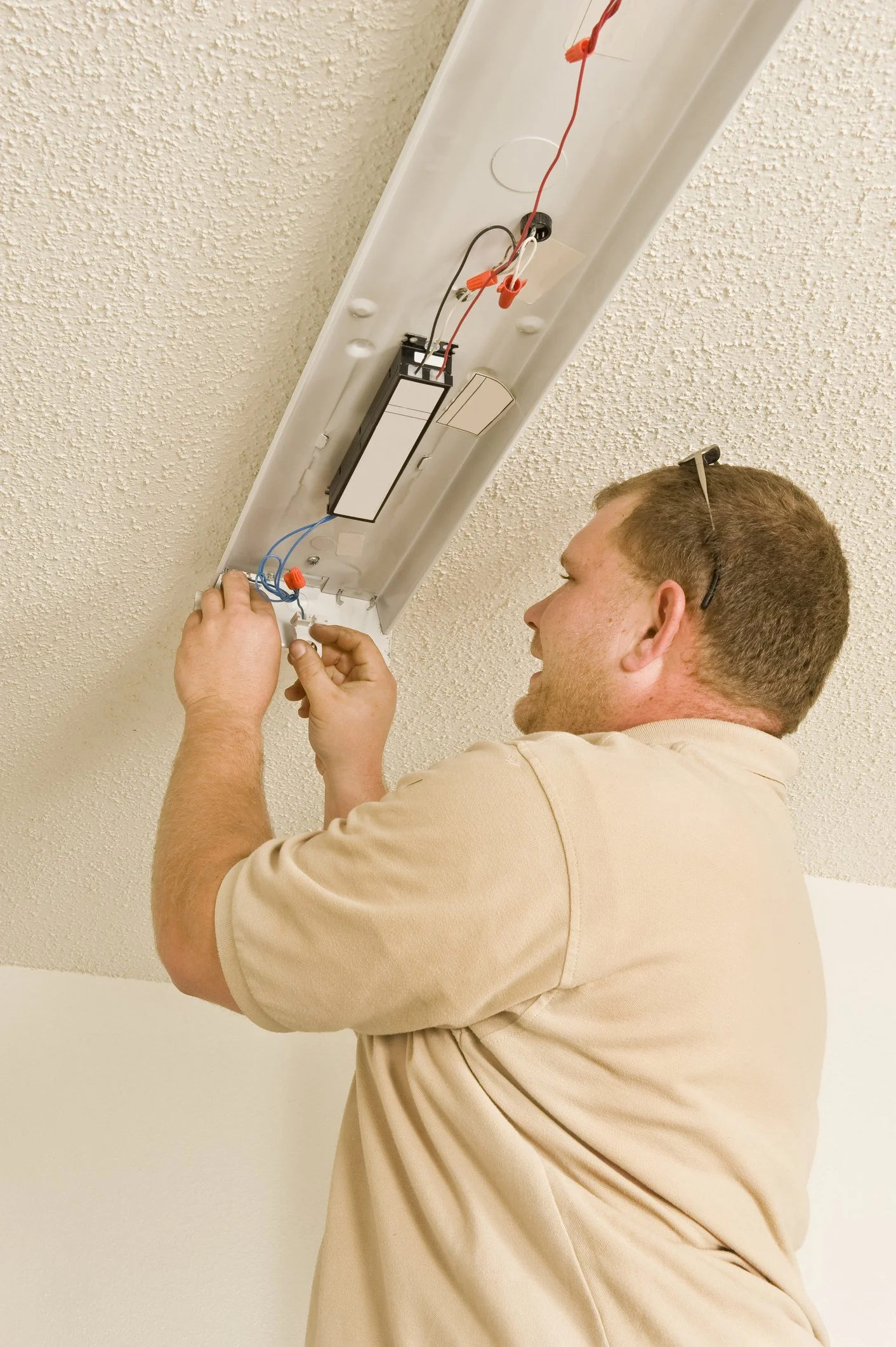
Step 4: Remove The Fluorescent Tubes And Ballast
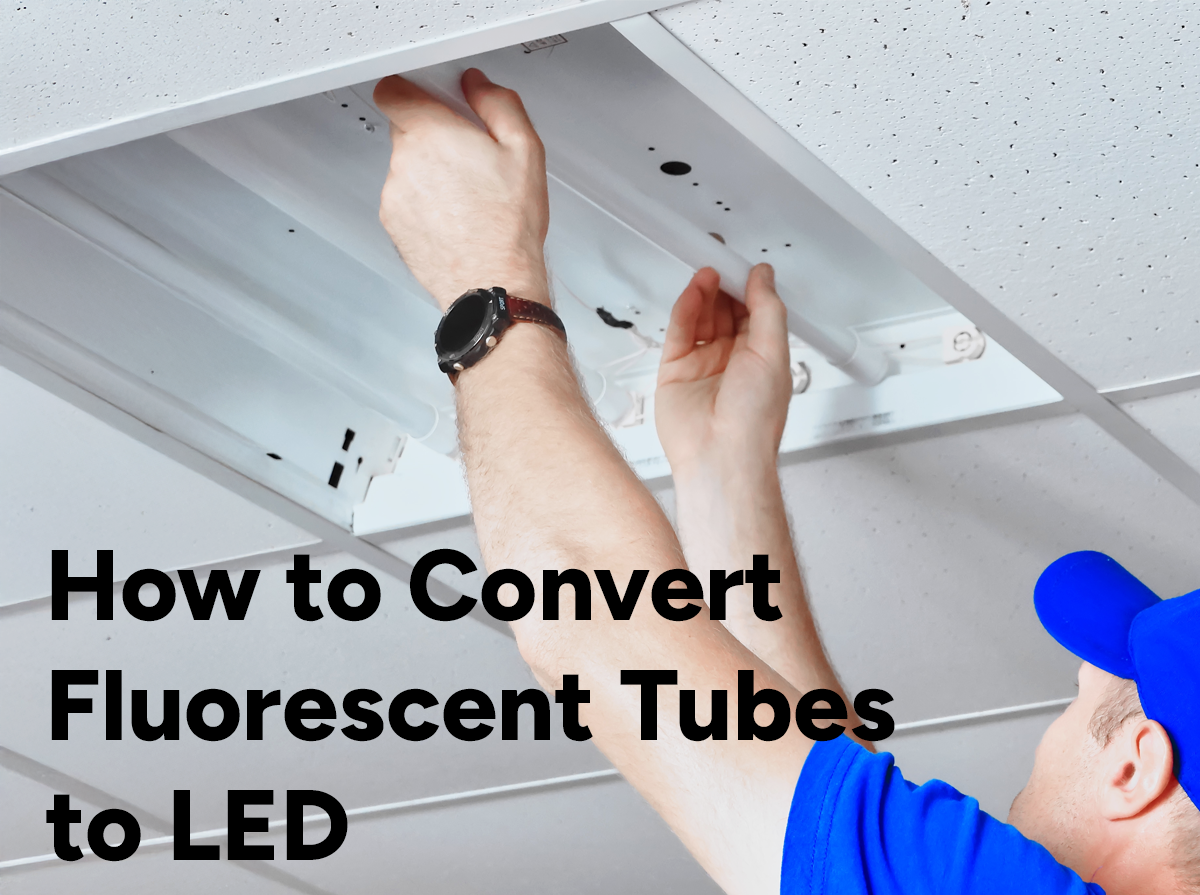
Once power is safely disconnected, remove the existing fluorescent tubes carefully.
Fluorescent lamps contain small amounts of mercury, so avoid twisting or forcing the lamps during removal. Place removed tubes somewhere secure where they cannot roll or break during the retrofit process.
Next, remove the fixture cover or ballast channel to expose the internal wiring and ballast assembly.
At this stage, the process differs depending on whether you are installing:
Plug-and-play LED tubes
Ballast bypass LED tubes
Hybrid LED tubes
For Plug-And-Play Installations
If you are using ballast-compatible LED tubes, the ballast remains in place.
In most cases, the process is simple:
Remove the fluorescent lamps
Verify ballast compatibility
Install the LED replacement tubes
Restore power
No rewiring is required.
However, if the ballast shows signs of:
Overheating
Buzzing
Leakage
Burn marks
It should be replaced before installing plug-and-play LED tubes. A failing ballast can prevent the LEDs from operating correctly and may shorten their lifespan. If the ballast has already failed or is nearing the end of its service life, you may also want to consider switching to ballast bypass or hybrid LED tubes to eliminate future ballast maintenance.
For Ballast Bypass Installations
Ballast bypass retrofits require disconnecting the ballast from the circuit entirely.
Most installers either:
Remove the ballast completely
Disconnect it electrically and leave it physically mounted inside the fixture
The wiring must then be reconfigured according to the LED tube manufacturer’s diagram.
Depending on the LED tube design, this may involve:
Single-ended wiring
Double-ended wiring
Socket replacement
Non-shunted tombstones
Follow the wiring instructions exactly. Ballast bypass LED tubes are not universally wired the same way.
If you are not comfortable performing line-voltage fixture rewiring, hire a licensed electrician.
Step 5: Install the LED Tubes
Once the fixture wiring is complete, the LED tubes can be installed.
For plug-and-play systems, installation is usually identical to fluorescent lamps:
Insert the pins into the sockets
Rotate the tube into place
Restore power
For ballast bypass systems, verify the tube orientation before installation.
Some direct-wire LED tubes are clearly labeled for:
Powered end
Neutral end
Single-ended input
Installing the tube backward on a single-ended system may prevent operation or damage the tube.
After the tubes are installed:
Restore power at the breaker
Turn the fixture on
Verify proper operation
The tubes should illuminate instantly without warm-up time.
Check for:
Flickering
Uneven brightness
Buzzing
Dark sections
Incorrect color temperature
If problems occur, disconnect power again and recheck:
Wiring configuration
Socket type
Ballast compatibility
Tube orientation
If the fixture does not operate as expected after you've verified the wiring, tube orientation, and compatibility, turn off the power and contact a licensed electrician. They can safely identify and correct wiring or fixture issues before the system is put back into use.
Common Fluorescent-To-LED Retrofit Mistakes
Here are some common fluorescent-to-LED retrofit mistakes:
Buying Incompatible Plug-And-Play Tubes
One of the biggest retrofit mistakes is assuming all ballast-compatible tubes work with all ballasts.
They do not.
Always verify compatibility using the LED manufacturer’s approved ballast list before purchase.
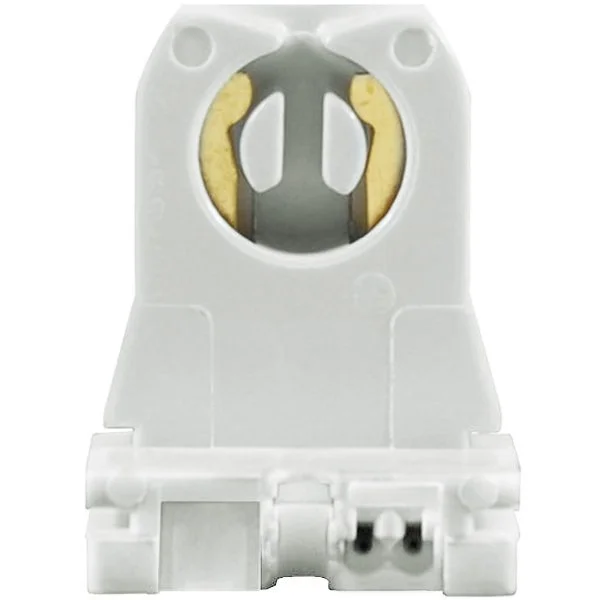
Shunted T8 Socket
Ignoring Socket Requirements
Some ballast bypass systems require non-shunted tombstones.
Installing the wrong socket type can create:
Startup failure
Electrical hazards
Incorrect tube operation
Mixing Color Temperatures
Mixing 3500K, 4000K, and 5000K tubes in the same space creates inconsistent lighting appearance.
Large commercial retrofits should standardize color temperature throughout the project whenever possible.
Forgetting Fluorescent Disposal Requirements
Fluorescent lamps contain mercury and should be disposed of according to local hazardous waste regulations.
Large retrofit projects often use commercial lamp recycling services.
Overlooking Old Fixture Condition
Some fluorescent fixtures are simply too deteriorated for worthwhile retrofit.
Fixtures with brittle wiring, corroded housings, yellowed lenses, or cracked sockets may justify full fixture replacement instead of tube retrofits.
Should You Retrofit or Replace the Fixture Entirely?
Not every fluorescent fixture should automatically be retrofitted.
In many facilities, LED tube conversion is the most cost-effective option because it modernizes lighting without replacing the fixture housing itself.
Retrofits work especially well when:
Fixture housings remain in good condition
The facility wants minimal disruption
Existing fixture layouts already work well
Budget constraints favor phased upgrades
However, full fixture replacement may make more sense when:
Fixtures are physically deteriorating
The lighting layout needs redesign
Better optics or controls are desired
Maintenance access is difficult
Aesthetic modernization matters
Modern LED fixtures can provide:
Better optical efficiency
Integrated controls
Cleaner appearance
Higher efficacy
Simplified installation
For many large commercial facilities, the best long-term solution depends on the age and condition of the existing infrastructure.
How 1000Bulbs Helps Simplify LED Retrofits
1000Bulbs carries a wide selection of LED retrofit tubes, including:
Plug-and-play LED tubes
Ballast bypass LED tubes
Hybrid LED systems
T8, T12, and T5 replacements
US-based lighting specialists are available Monday through Friday, 7 a.m. to 7 p.m. CST to help identify compatible LED retrofit options, verify ballast compatibility, and assist with larger commercial conversion projects.
For facilities planning phased upgrades, 1000Bulbs can also help compare retrofit strategies based on fixture type, operating hours, and long-term maintenance goals.
Call 1-800-624-4488 or browse LED retrofit tubes, ballast bypass systems, and commercial lighting products at 1000Bulbs.com.
Need Help Selecting Compatible LED Retrofit Tubes?
Converting fluorescent tubes to LED is one of the most practical ways to reduce energy usage, simplify maintenance, and modernize existing commercial lighting systems without replacing entire fixtures.
The key is choosing the correct retrofit method.
Plug-and-play LED tubes minimize installation labor. Ballast bypass systems eliminate ballast maintenance entirely. Hybrid tubes provide flexibility for phased retrofit strategies.
Once fixture type, ballast compatibility, and wiring configuration are understood, most fluorescent systems can be converted successfully with substantial long-term operating benefits.
For help selecting compatible LED retrofit tubes or planning a larger fluorescent conversion project, 1000Bulbs lighting specialists are available to help evaluate the best retrofit path for your facility.
FAQs
Can Fluorescent Tubes Be Replaced With LED Tubes?
Yes. Most fluorescent fixtures can be converted to LED using plug-and-play, ballast bypass, or hybrid LED retrofit tubes depending on the fixture and ballast configuration.
Do I Need To Remove The Ballast To Install LED Tubes?
Not always. Plug-and-play LED tubes operate with compatible existing ballasts, while ballast bypass tubes require the ballast to be removed or disconnected.
What Is Ballast Bypass?
Ballast bypass means removing the fluorescent ballast from the electrical circuit so the LED tube operates directly from line voltage.
Are LED Tubes Brighter Than Fluorescent Tubes?
Many LED tubes provide similar or better usable light output while consuming less energy than fluorescent lamps.
What Is The Difference Between Type A And Type B LED Tubes?
Type A tubes are ballast-compatible plug-and-play systems. Type B tubes are ballast bypass systems that require rewiring.
Can I Install LED Tubes Myself?
Plug-and-play LED tubes are often straightforward to install. Ballast bypass conversions involve line-voltage rewiring and are generally best handled by qualified electricians.
Do LED Tubes Use Less Electricity Than Fluorescent Tubes?
Yes. LED tubes usually consume significantly less power while delivering comparable light output.
Can T12 Fixtures Be Converted To LED?
Yes. Many T12 fluorescent fixtures can be retrofitted successfully using compatible LED replacement tubes.