
Ballasts vs LED Drivers: What’s the Difference?
| What This Article Covers |
|---|
Ballasts and LED drivers both regulate power to a light source, but they are built for completely different lighting technologies and are not interchangeable. Confusing them is one of the most common and costly mistakes in commercial LED retrofit projects. This guide explains how each component works, how to recognize ballast failure, and how to decide between a ballast replacement and a full LED upgrade. It also covers plug-and-play vs. ballast bypass LED tubes, common retrofit mistakes to avoid, and which commercial environments benefit most from LED driver systems. Best for: contractors, facility managers, maintenance teams, warehouse operators, and anyone planning an LED retrofit or troubleshooting an existing fluorescent system. |
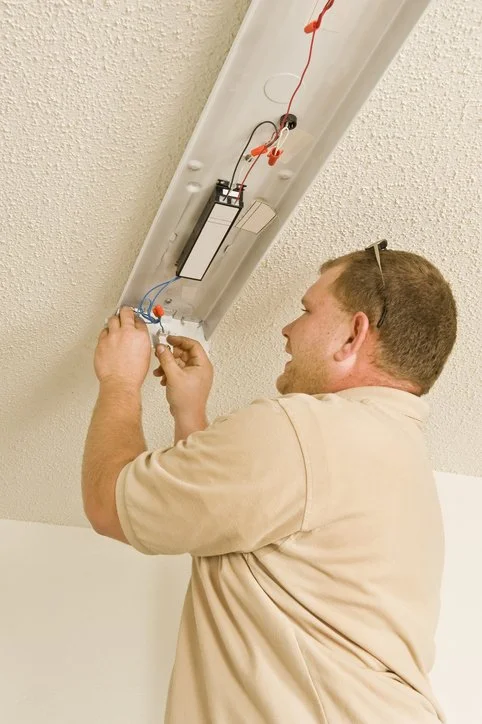
Electrician replacing a ballast in a fluorescent fixture
If you’ve started an LED retrofit project and suddenly found yourself comparing ballasts, LED drivers, bypass tubes, and compatibility charts, you’re not alone. One of the most common points of confusion in commercial lighting upgrades is understanding the difference between a ballast and an LED driver. Although the terms are often used interchangeably, they support completely different lighting technologies and serve different functions within a lighting system.
Understanding ballast vs. LED driver systems matters because incorrect assumptions can create expensive problems. Compatibility issues may lead to flickering lights, shortened fixture life, failed inspections, unnecessary maintenance, or warranty concerns. Whether you're replacing fluorescent fixtures in a warehouse, upgrading office lighting, or planning a large-scale commercial retrofit, understanding how each component works can help you make more informed decisions before installation begins.
Why So Many People Confuse Ballasts and LED Drivers
The confusion around ballasts and LED drivers usually starts during retrofit work. Someone opens an existing fluorescent fixture, sees a rectangular electrical component inside, and assumes the replacement LED system uses the same hardware. In reality, while both devices regulate power to a light source, they do it in very different ways and for different technologies.
Ballasts are designed for fluorescent and HID lamps. LED drivers are designed specifically for LEDs. They are not interchangeable, even though they perform a similar high-level job.
This misunderstanding becomes especially common when replacing T8 fluorescent tubes with LED alternatives. For example, a maintenance manager might install plug-and-play LED tubes expecting immediate compatibility, only to discover the existing ballast is incompatible or already failing. The result can include flickering, delayed startup, inconsistent brightness, or total fixture failure.
In older commercial buildings, another layer of confusion comes from the variety of legacy systems still in operation. Magnetic ballasts, electronic ballasts, direct-wire LED retrofits, hybrid tubes, and integrated LED fixtures may all exist within the same facility. Without understanding which system controls power delivery, troubleshooting becomes much harder.
That’s why identifying the correct component before purchasing retrofit products is one of the most important steps in any lighting upgrade.
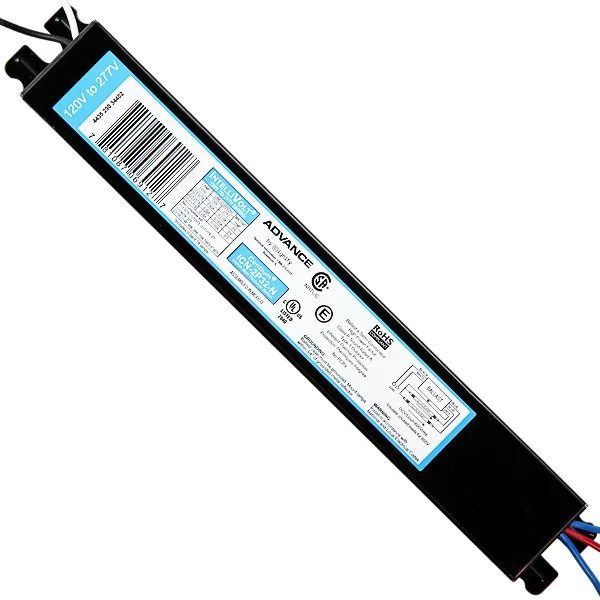
Instant Start Fluorescent Ballast
What Is a Ballast?
A ballast is a current-regulating device used in fluorescent and HID lighting systems. Its primary job is to control electrical current during startup and operation. Without a ballast, fluorescent lamps would draw excessive current, overheat, and fail very quickly.
When fluorescent lamps start, they require a high initial voltage to strike the arc between electrodes inside the tube. Once the lamp is operating, the ballast limits current flow to keep the lamp stable and prevent damage.
There are two primary ballast types still found in commercial lighting systems:
Magnetic Ballasts
Magnetic ballasts are older technology commonly found in aging warehouses, schools, manufacturing facilities, and office buildings. They use copper windings and magnetic components to regulate power and are most commonly associated with T12 fluorescent tubes and two-pin CFL lamps.
These ballasts are:
Heavier than electronic versions
Less energy efficient
More likely to produce audible humming
More susceptible to flickering
Slower during startup, especially in cold environments
Magnetic ballasts have largely been phased out and discontinued as facilities transition to more efficient lighting systems. However, many buildings still operate older magnetic ballast fixtures because the systems remain functional, even as maintenance costs continue to rise with age.
Electronic Ballasts
Electronic ballasts replaced magnetic designs in many fluorescent systems because they operate more efficiently and improve lighting performance. Instead of magnetic regulation, they use electronic circuitry to control lamp current.
Compared to magnetic ballasts, electronic versions are:
More energy efficient
Quieter during operation
Better at reducing flicker
Faster during startup
More compact and lightweight
Most fluorescent fixtures still in active commercial use today rely on electronic ballasts.
Several warning signs indicate ballast failure may be approaching:
Buzzing or humming sounds
Flickering after lamp replacement
Slow startup
Uneven brightness
Darkened lamp ends
Intermittent shutdowns
Burning odors near the fixture
Quick tip: If a fluorescent fixture continues flickering after replacing the lamps, the ballast is often the first component worth checking.
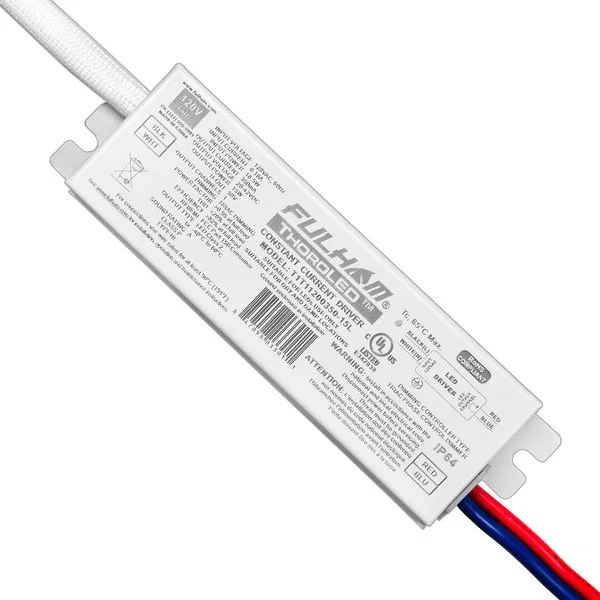
Constant Current LED Driver
What Is an LED Driver?
An LED driver is a regulated power supply designed specifically for LED lighting systems. LEDs operate very differently from fluorescent lamps and require carefully controlled electrical input to function properly. The LED driver converts incoming AC line voltage into the regulated DC power LEDs need for stable operation.
In most LED fixtures and integrated LED lamps, the driver is already built into the product. End users typically do not need to purchase a separate LED driver when buying an LED fixture or lamp. Separate replacement drivers are most commonly used when servicing commercial LED fixtures after a driver failure or when building custom LED lighting systems.
Because LEDs are highly sensitive to current and voltage fluctuations, the driver plays a major role in fixture performance, efficiency, and lifespan. Unlike fluorescent systems, where the ballast primarily limits current, LED drivers actively regulate electrical output to protect LEDs and maintain consistent illumination.
Constant Current LED Drivers
Constant current drivers deliver a fixed current output while adjusting voltage as needed. These drivers are commonly used in:
LED panels
High bays
Troffers
Downlights
Integrated commercial fixtures
Current is typically measured in milliamps or amps, such as 350mA, 700mA, or 1050mA. Matching the correct current rating to the LED load is critical for proper performance.
Constant Voltage LED Drivers
Constant voltage drivers provide a stable DC voltage output, most commonly:
12V DC
24V DC
These drivers are frequently used for:
LED strip lighting
Tape lighting
Signage
Accent lighting
Architectural applications
In these systems, voltage consistency matters more than current regulation because the LED products themselves already contain current-limiting components.
One reason LED systems outperform fluorescent technology in energy efficiency is driver performance. Quality LED drivers often convert 85 to 95 percent of incoming power into usable electricity with minimal energy lost as heat.
Lifespan is another major advantage. Many commercial-grade LED drivers are rated for 50,000 hours or more, which often matches or exceeds the service life of the fixture itself.
Ballasts vs. LED Drivers: Side-By-Side Comparison
While both components regulate power to a lighting system, the differences between ballasts and LED drivers become much clearer when you compare real-world performance, efficiency, maintenance requirements, and compatibility.
Energy Efficiency
One of the biggest reasons facilities move away from fluorescent systems is energy consumption. Older magnetic ballasts waste a noticeable amount of electricity as heat during operation. Electronic ballasts improved efficiency substantially, but they still cannot match modern LED systems.
LED drivers typically operate at 85 to 95 percent efficiency, meaning most incoming electricity is converted into usable light output instead of wasted heat. That efficiency advantage is a major reason LED retrofits regularly reduce lighting energy consumption by 50 to 70 percent in commercial environments.
For facilities operating lights 10 to 16 hours per day, the difference becomes significant very quickly. Warehouses, schools, parking garages, and retail spaces often see measurable reductions in utility costs after converting from ballast-based fluorescent systems to LED driver systems.
Lifespan Expectations
Electronic fluorescent ballasts are often rated around 50,000 hours under controlled operating conditions. However, real-world conditions frequently shorten that lifespan. Excessive heat, frequent switching cycles, vibration, and inconsistent power quality can all accelerate ballast failure.
LED drivers are commonly rated between 50,000 and 60,000 hours or more, especially in commercial-grade fixtures. Many manufacturers also support these products with longer warranty periods, particularly in high-performance commercial applications.
The fixture design matters as well. Poor thermal management can shorten driver life just as excessive heat damages ballasts. That is why driver quality and fixture engineering are both important during retrofit planning.
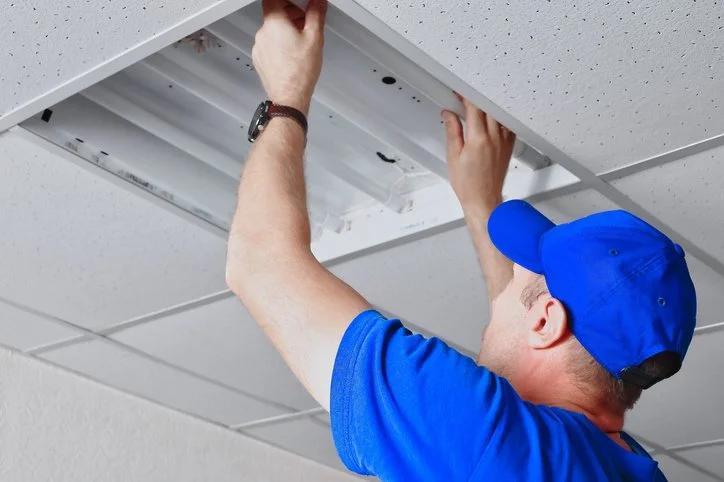
Tubes being replaced in an office troffer fixture as part of ongoing maintenance.
Maintenance Differences
Maintenance is one of the largest long-term cost differences between fluorescent and LED systems.
Ballast-based systems eventually require:
Lamp replacement
Ballast replacement
Troubleshooting labor
Fixture downtime
In facilities with high ceilings or difficult access, those maintenance costs increase substantially. Replacing a failed ballast above warehouse racking or inside a gymnasium can require lifts, labor scheduling, and operational disruption.
LED driver systems reduce many of those recurring maintenance demands. With fewer replacement cycles and fewer failure points, maintenance teams spend less time servicing fixtures and more time focusing on other facility priorities.
For large commercial properties, this reduction in maintenance labor often becomes just as valuable as the energy savings themselves.
Compatibility Concerns
Compatibility is where many retrofit mistakes happen.
Ballasts are lamp-specific. A fluorescent ballast designed for one lamp type or wattage may not work properly with another. Magnetic and electronic ballasts also operate differently and cannot simply be swapped interchangeably without verifying compatibility.
LED drivers require the same level of precision. The voltage and current output must match the LED load requirements exactly. An improperly matched driver can lead to:
Flickering
Reduced light output
Overheating
Premature failure
Inconsistent dimming performance
This becomes especially important in commercial retrofits where multiple fixture types exist throughout the same facility.
For example, installing a 24V constant voltage driver on a fixture requiring constant current regulation can damage the LEDs or prevent proper operation entirely.
Startup Performance
Startup performance is another area where LED systems typically outperform fluorescent technology.
Older magnetic ballasts often produce:
Delayed startup
Flickering during ignition
Reduced brightness in cold temperatures
Slow warmup times
These issues become especially noticeable in refrigerated environments, parking garages, outdoor fixtures, and unconditioned warehouses.
LED systems paired with quality drivers reach full brightness almost instantly, even in cold environments. This immediate startup improves both user experience and operational reliability in demanding commercial applications.
Ballast vs. Driver Troubleshooting Shortcut
One of the easiest ways to identify whether a fixture uses a ballast or LED driver is to look at the type of light source installed.
| Fixture Type | Power Regulation Component |
|---|---|
| T8 or T12 Fluorescent Fixture | Ballast |
| Compact Fluorescent (CFL) Fixture | Ballast |
| HID High Bay or Metal Halide Fixture | Ballast |
| Integrated LED Panel, Troffer, of High Bay | LED Driver |
| LED Strip or Tape Lighting | LED Driver |
| Modern LED Wall Pack | LED Driver |
If the fixture uses fluorescent or HID lamps, it likely relies on a ballast. If it uses integrated LEDs, it almost certainly contains an LED driver. Knowing which component is present can significantly reduce troubleshooting time and prevent compatibility issues during retrofits.
When Should You Replace a Ballast?
In some situations, replacing a ballast still makes sense, especially if the existing fluorescent system remains relatively modern and a full retrofit is not currently in the budget.
One of the clearest signs of ballast failure is persistent flickering after replacing the lamps themselves. If new fluorescent tubes continue flickering or operating inconsistently, the ballast is often the root cause.
Buzzing or humming is another common warning sign, particularly with older magnetic ballasts. While some noise is normal in aging systems, excessive humming usually indicates internal wear or electrical instability.
Delayed startup is also worth paying attention to. If lamps take several seconds to illuminate fully, or if brightness gradually ramps up after powering on, the ballast may be degrading.
Additional warning signs include:
Burn marks near the ballast
Darkened lamp ends
Overheating fixtures
Burning smells
Random shutdowns
Intermittent operation
In many facilities, the decision becomes whether to replace the ballast temporarily or move directly into an LED retrofit.
If your ballast is still under manufacturer warranty, contact 1000Bulbs at 1-800-624-4488. The lighting team can help confirm compatibility, review replacement options, and determine whether repairing the existing system or upgrading to LED makes the most sense for your application.
When Should You Upgrade to LED Lighting Instead?
If you are already investing time and labor into fixture repairs, a full LED conversion is often the better long-term decision.
In most retrofit situations, the LED driver is already included inside the new LED fixture or lamp. The decision is usually whether to continue maintaining a fluorescent ballast-based system or replace it with a modern LED lighting system designed for greater efficiency and longer service life.
Replacing fluorescent lamps and ballasts may restore operation temporarily, but it does not eliminate the underlying limitations of older lighting technology. Energy consumption, recurring maintenance, and future ballast failures remain ongoing considerations. LED lighting systems address many of these challenges while delivering improved performance and lower operating costs over time.
Commercial LED systems typically consume 50 to 70 percent less electricity than fluorescent systems while also reducing maintenance frequency. In facilities operating hundreds or thousands of fixtures, the long-term savings can become substantial.
For warehouses, schools, hospitals, manufacturing plants, and retail stores, maintenance reduction alone often justifies the upgrade. Every avoided ballast replacement means less labor, less downtime, and fewer disruptions.
Modern LED drivers also support advanced lighting controls that many fluorescent systems struggle to integrate with effectively, including:
0-10V dimming
Occupancy sensors
Motion controls
Smart building systems
Daylight harvesting
DALI lighting controls
These controls create additional opportunities for energy savings and operational flexibility.
In many commercial environments, the payback period for a full LED retrofit falls within two to four years, depending on operating hours, energy rates, and maintenance costs.
Ballast Bypass vs Plug-And-Play LEDs
One of the most common decisions during an LED retrofit involves choosing between plug-and-play tubes and ballast bypass tubes. Both options convert fluorescent fixtures to LED, but they handle power differently and create different long-term maintenance outcomes.
Plug-And-Play LED Tubes
Plug-and-play LEDs, also called Type A tubes, are designed to work with an existing compatible ballast. Installation is relatively simple because the ballast remains in the fixture and no rewiring is required.
For many smaller projects, this approach offers clear advantages:
Faster installation
Minimal electrical modification
Reduced labor costs upfront
Easier retrofits in occupied spaces
However, the ballast still remains part of the system. That means if the ballast eventually fails, the LED tube stops working too. In older commercial fixtures, this can become a recurring maintenance issue.
Plug-and-play systems work best when:
Existing ballasts are relatively new
Downtime must be minimized
Rewiring access is limited
The retrofit is temporary or phased
Note: Ballasts must be specifically listed as compatible with the LED tube being installed. LED tubes are not universally compatible with all ballasts, so always verify compatibility between the tube and ballast before installation.
Ballast Bypass LED Tubes
Ballast bypass tubes, also called direct-wire or Type B tubes, remove the ballast from the circuit entirely. The fixture is rewired so that line voltage powers the LED tube directly.
This approach requires more installation work initially, but it eliminates the ballast as a future failure point.
Long-term advantages include:
Higher overall system efficiency
Lower maintenance costs
Fewer replacement components
Improved long-term reliability
For warehouses, schools, industrial facilities, and large commercial properties, ballast bypass retrofits often deliver stronger long-term ROI because maintenance teams no longer need to service aging ballasts.
Hybrid Tubes
Hybrid or Type A+B tubes offer additional flexibility because they can operate either with a compatible ballast or in bypass mode after rewiring.
These products are useful during phased retrofit projects where:
Some fixtures still contain functioning ballasts
Other fixtures are being rewired immediately
Maintenance teams want flexibility over time
The right retrofit path depends on the project itself. Plug-and-play systems can make sense for quick upgrades or smaller facilities. Direct-wire retrofits usually make more financial sense for long-term commercial applications with heavy operating hours.
Safety note: Ballast bypass retrofits require rewiring and should always be performed by a qualified electrician.
Common Retrofit Mistakes to Avoid
Even experienced maintenance teams can run into compatibility issues during lighting upgrades. Most retrofit problems happen because electrical requirements were not verified before installation.
Some of the most common mistakes include:
Incorrect power compatibility: When replacing LED drivers in existing fixtures, the replacement driver must match the fixture's voltage and current requirements. An incorrect replacement can cause flickering, reduced output, overheating, or premature failure.
Voltage mismatch: installing a 120V driver into a 277V commercial system can damage equipment and create serious safety concerns.
Incorrect dimming compatibility: not all dimmers communicate with all drivers. A mismatch between TRIAC, 0-10V, or DALI controls can cause inconsistent dimming or complete failure.
Fixture incompatibility: retrofit kits do not fit every housing type. Dimensions, mounting points, and thermal performance all matter.
Assuming ballast compatibility: not every existing ballast supports plug-and-play LED tubes, even if the fixture appears compatible physically.
Pro tip: Before purchasing retrofit products, call the US-based lighting experts at 1-800-624-4488. Verifying compatibility before installation can help prevent expensive delays, rewiring issues, and product mismatches.
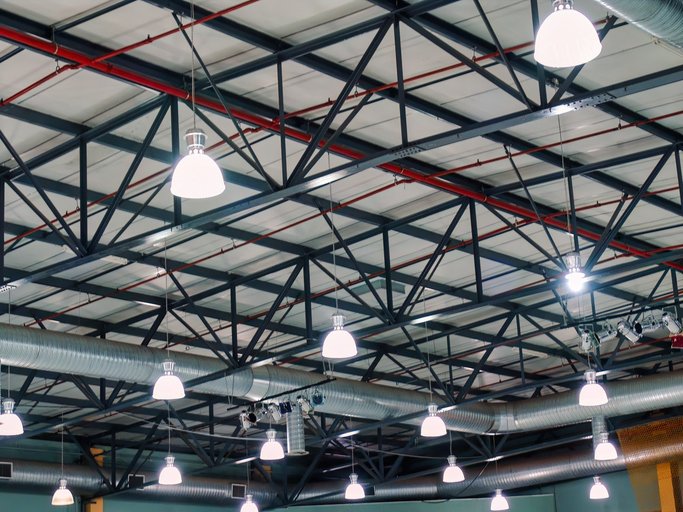
New LED high bays installed in a warehouse, replacing older HID fixtures.
Commercial Applications That Benefit Most From LED Drivers
While almost any facility can benefit from LED retrofits, certain commercial environments see especially strong returns from driver-based LED systems.
Warehouses and Distribution Centers
Warehouses operate lighting for long hours across large square footage. High-bay LED fixtures paired with quality drivers dramatically reduce energy consumption while improving light consistency throughout aisles and storage areas.
Many facilities also integrate occupancy sensors and motion controls to reduce unnecessary runtime during low-traffic periods.
Offices
Office environments benefit from stable, flicker-free LED lighting that improves visual comfort throughout the workday. LED panels with 0-10V dimming compatibility also support daylight harvesting systems that automatically adjust brightness based on natural light conditions.
Manufacturing facilities
Industrial facilities often expose lighting systems to vibration, heat, dust, and extended operating hours. Commercial LED drivers built for demanding environments generally outperform fluorescent systems under these conditions while requiring less maintenance downtime.
Schools and Universities
Educational campuses frequently manage hundreds or thousands of fixtures across classrooms, gyms, hallways, and administrative buildings. Longer LED lifespan reduces maintenance interruptions while lowering labor costs for facility departments.
Retail Stores
Modern retail lighting often relies on flexible LED systems that support tunable white lighting and color-selectable fixtures. Drivers capable of supporting these controls help retailers adjust merchandising presentation without rewiring entire lighting systems.
How 1000Bulbs Helps Simplify Retrofits
Lighting retrofits involve more than simply swapping one lamp for another. Compatibility, voltage requirements, dimming systems, fixture configuration, and operating environment all affect long-term performance.
That is why 1000Bulbs provides access to US-based lighting professionals who help customers identify the correct retrofit products before installation begins. We offer a wide selection of lighting products, including LED drivers, ballasts, plug-and-play LED tubes, ballast bypass tubes, retrofit kits, commercial fixtures, and industrial lighting solutions.
For larger commercial projects, bulk pricing may also help reduce total retrofit costs across facility-wide upgrades.
Most importantly, the support team can help confirm driver compatibility with existing fixtures and LED loads, which is one of the most common pain points during retrofit planning.
Final Thoughts: Choosing the Right Power System for Modern Lighting
Ballasts and LED drivers both regulate electrical power, but they serve entirely different lighting technologies. Ballasts are used in fluorescent and HID systems, while LED drivers support LED lighting by delivering the regulated power LEDs require for reliable operation. Understanding the difference is essential when troubleshooting fixtures, planning retrofits, or evaluating upgrade options.
For facilities still operating fluorescent systems, replacing a failed ballast may be the most practical short-term solution. However, many organizations are choosing LED lighting upgrades to reduce energy consumption, lower maintenance costs, and improve long-term reliability.
If you're unsure which solution is right for your application, the lighting professionals at 1000Bulbs can help evaluate your existing system, verify compatibility, and recommend products that support your operational goals.
FAQs
What does an LED driver do?
An LED driver converts incoming AC power into the regulated DC power LEDs require for stable operation. It protects LEDs from voltage and current fluctuations while maintaining consistent light output and efficiency.
Can I use an LED bulb with a fluorescent ballast?
Some LED tubes are designed to work with compatible fluorescent ballasts, but not all are. Plug-and-play LED tubes require ballast compatibility verification, while ballast bypass tubes remove the ballast entirely.
Are LED drivers more efficient than ballasts?
LED drivers are generally much more efficient than fluorescent ballasts. Most quality LED drivers operate at 85 to 95 percent efficiency, helping reduce energy consumption and heat generation.
How long do LED drivers last?
Most commercial LED drivers are rated for 50,000 to 60,000 hours or more. Actual lifespan depends on operating conditions, fixture temperature, and overall driver quality.
Should I bypass my ballast when converting to LED?
Ballast bypass retrofits usually provide better long-term efficiency and lower maintenance costs because the ballast is removed from the system entirely. However, installation requires rewiring and should be performed by a qualified electrician.