
How to Choose Commercial LED High Bay Fixtures for High Ceilings
| What This Article Covers |
|---|
High-ceiling commercial spaces — warehouses, gyms, manufacturing plants, and large retail facilities — have unique lighting requirements that standard commercial guides don’t address. Getting the fixture type, lumen output, beam angle, and controls strategy right determines whether your investment delivers consistent floor-level visibility or leaves workers navigating dark gaps and uneven light. This guide covers how to choose between UFO high bays, linear high bays, and industrial bulbs; how to calculate the footcandles your space actually needs; how LED performance compares to metal halide and HPS on energy, lifespan, and color rendering; and how to build a realistic ROI case including utility rebates. It also covers the most common specification mistakes that lead to under-lit spaces, failed rebate applications, and expensive do-overs. Best for: facility managers, operations and maintenance directors, electrical contractors, procurement specialists, and warehouse or industrial operators planning an LED high bay retrofit or new installation. |
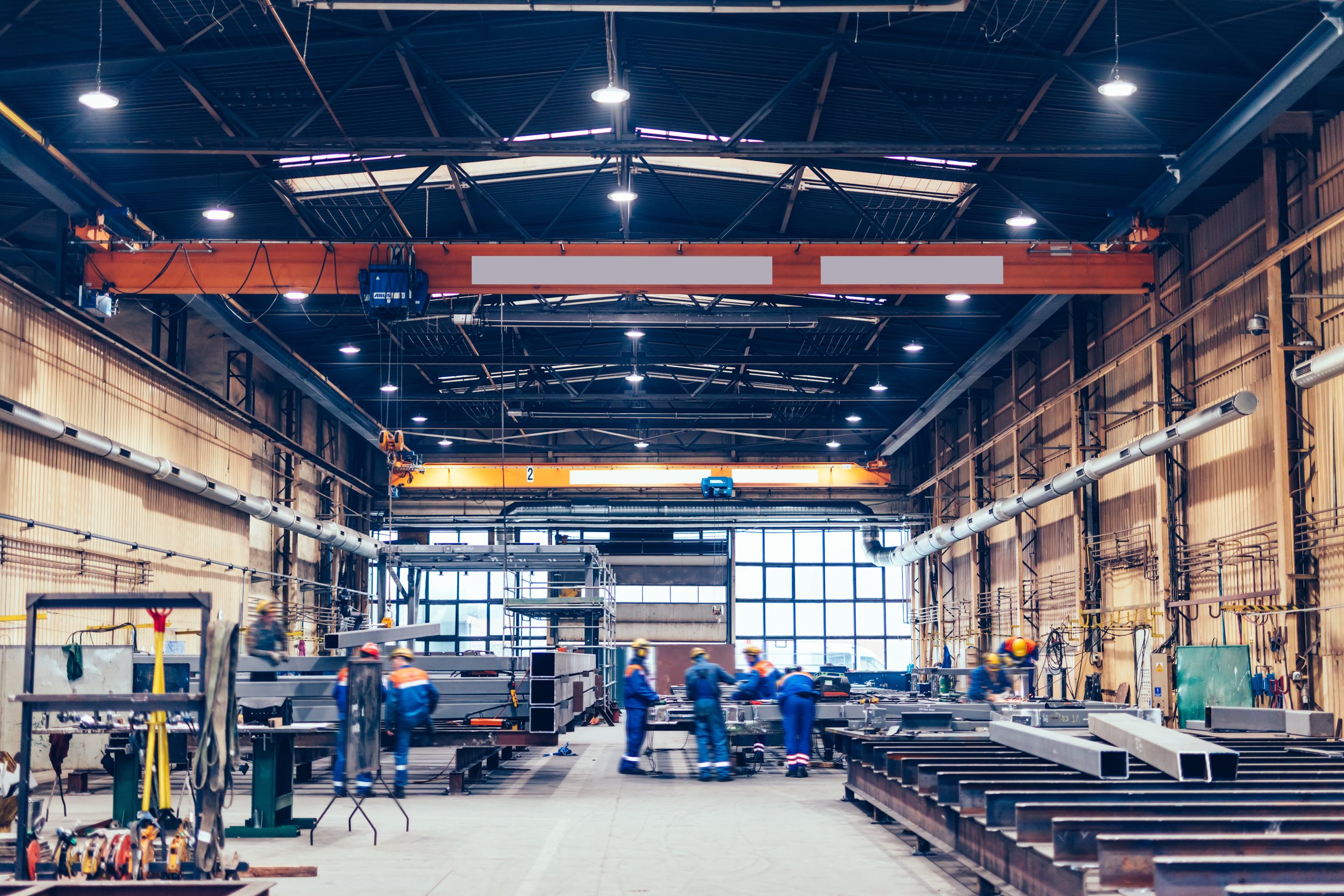
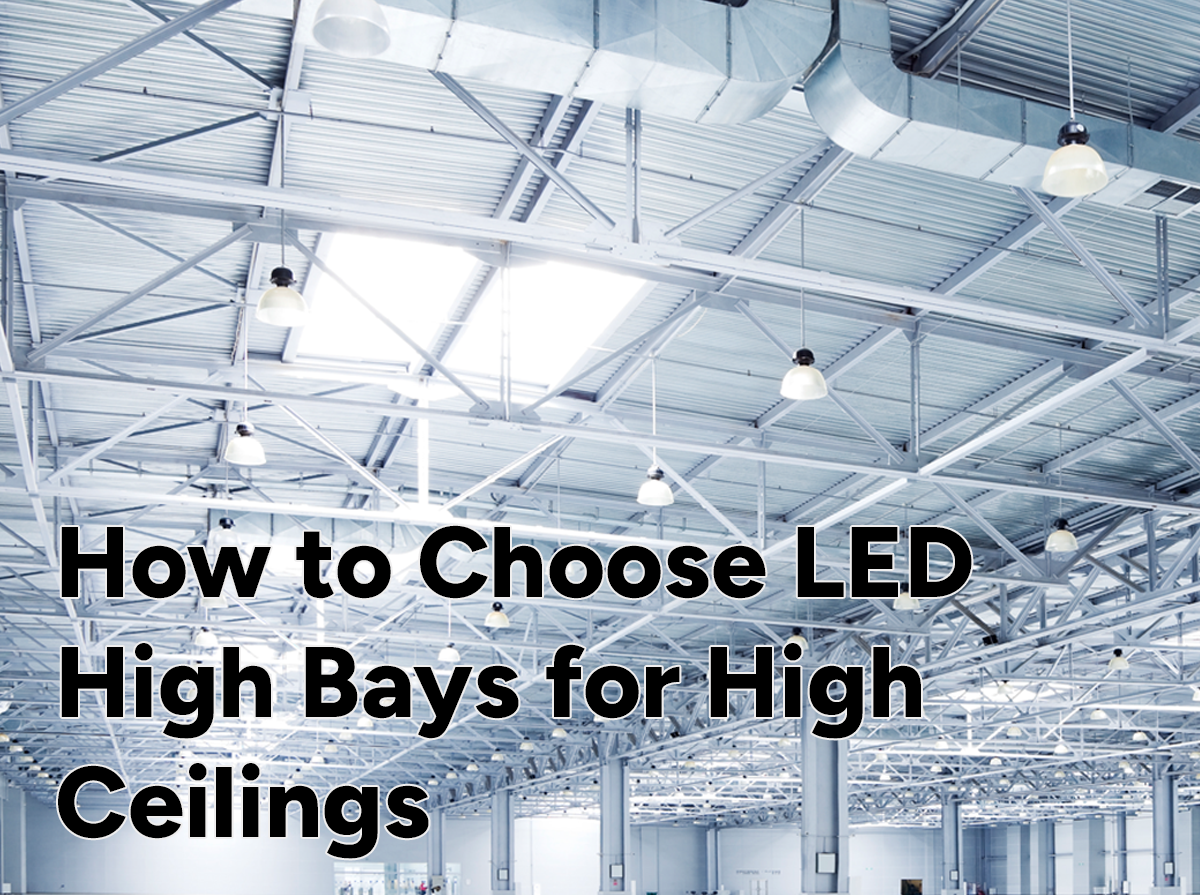
Choosing lighting for a facility with 20-, 30-, or even 40-foot ceilings involves far more than selecting the brightest fixture available. Ceiling height, fixture spacing, beam angle, light distribution, energy efficiency, and long-term maintenance all influence how well a lighting system performs once it is installed.
The wrong fixture can create uneven illumination, increase operating costs, and make maintenance more frequent and expensive. The right fixture delivers consistent visibility, improves worker safety, reduces energy consumption, and lowers the total cost of ownership over the life of the system.
This guide explains how to choose the best commercial LED high bay fixtures for warehouses, manufacturing facilities, gymnasiums, retail stores, and other high-ceiling environments. You'll learn how different fixture styles compare, how to determine the proper light levels for your space, and what specifications matter most before investing in a commercial lighting upgrade.
Why High Ceiling Lighting Is Different
Lighting a high-ceiling commercial space is not simply a matter of installing brighter bulbs.
As mounting height increases, light intensity at floor level drops rapidly. A fixture that feels extremely bright at 12 feet may provide inadequate illumination at 25 or 30 feet because the light spreads across a much larger area before reaching the floor.
As light travels farther from the fixture, it spreads across a larger area before reaching the floor. That wider distribution reduces illuminance unless the fixture is designed with sufficient lumen output and an appropriate beam angle. This is why commercial high bay fixtures are engineered differently than lighting intended for offices, classrooms, or retail spaces with lower ceilings.
That is why high-ceiling environments require bulbs specifically engineered for long-throw illumination and controlled beam distribution.
Warehouses, manufacturing facilities, gyms, and large retail spaces also create challenges that smaller commercial spaces usually do not face:
Wider fixture spacing
Larger open floor areas
Higher mounting heights
Increased glare potential
More difficult maintenance access
Greater dependence on uniform lighting coverage
Maintenance becomes especially important at height.
Replacing a failed fixture at 30 feet is not a quick maintenance call. It often requires lift equipment, scheduling, downtime coordination, and additional labor costs that add up quickly across large facilities.
Lighting quality also affects safety and operational performance more directly in industrial environments. Warehouses, loading docks, manufacturing floors, and active storage areas need enough floor-level illumination for equipment movement, picking accuracy, visibility, and worker comfort.
Organizations such as OSHA and the IES publish lighting guidance and recommendations for commercial work environments, which is one reason many facilities now approach LED upgrades strategically rather than simply replacing bulbs one-for-one.
Best Fixture Types for High Ceilings
Not every commercial LED fixture is designed for high mounting heights. The right choice depends on ceiling height, floor layout, fixture spacing, and the type of work being performed below.
UFO High Bays
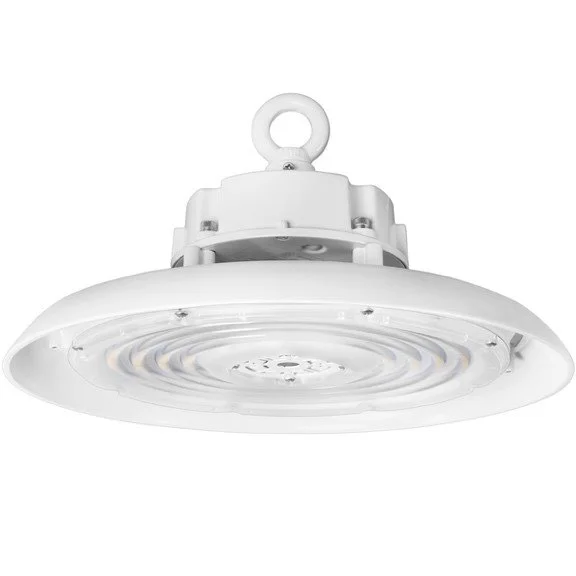
UFO high bays are the most common fixture type used in warehouses, distribution centers, gyms, and open industrial spaces.
These round bulbs are compact, high-output, and designed for ceilings commonly ranging from roughly 15 to 30 feet depending on wattage and spacing requirements. Their wide beam spread works especially well in large open floor plans where general area illumination is the priority.
Many facilities also choose UFO high bays because they are relatively simple to install and available in a wide range of lumen packages.
Modern UFO high bays are often available with:
Motion sensor compatibility
0–10V dimming
DLC listing
Emergency backup options
Mounting options typically include:
V-hooks with chain suspension
Aircraft cable suspension
Pendant mounting with compatible accessories
Surface mounting brackets on select models
All wiring connections still route through a junction box regardless of mounting method.
Linear High Bays
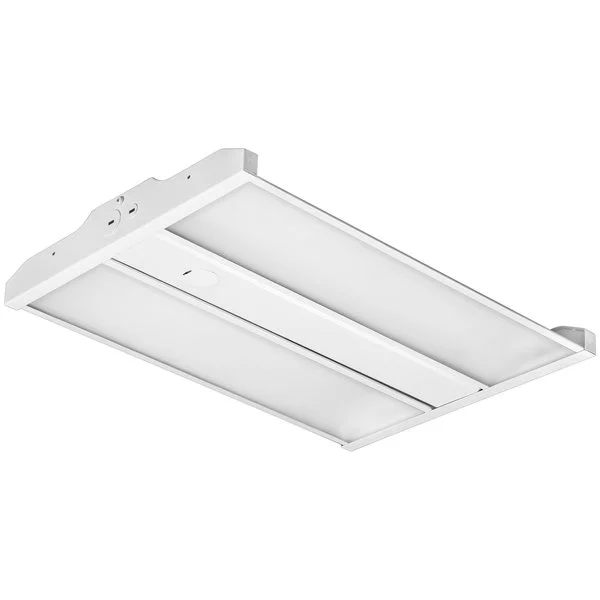
Linear high bays are designed for spaces with defined aisle layouts, conveyor systems, production lines, and organized rack structures.
Instead of producing a circular light pattern like a UFO fixture, linear high bays distribute light along the length of the fixture. That creates more consistent aisle illumination and reduces shadowing between rows.
They are especially common in:
Manufacturing facilities
Racked warehouse aisles
Distribution centers
Retail warehouse spaces
Conveyor and production environments
Because the fixture body is elongated, linear high bays distribute light more evenly along shelving rows, conveyor systems, and production lines. This can improve fixture spacing, reduce shadows between racks, and create more consistent visibility for employees working in aisle-based environments.
Linear bulbs also integrate well with lighting controls and automation systems. Many include 0–10V dimming compatibility along with occupancy sensor integration for additional energy savings in low-traffic areas.
For facilities exposed to moisture, dust, or wash-down conditions, IP-rated linear high bays are also available for harsher operating environments.

LED Panels
LED panels are sometimes misunderstood in commercial retrofit projects because they are not true high bay bulbs.
Panels are designed primarily for lower-ceiling finished spaces such as:
Offices
Conference rooms
Break rooms
Restrooms
Administrative areas within warehouses
They provide soft, highly uniform lighting, but they are not intended for large open warehouse ceilings above typical office heights.
Most LED panels also require a suspended T-grid ceiling system, which is rarely found on warehouse main floors or industrial production areas.
Many commercial facilities use both fixture types together. High bay fixtures illuminate warehouse floors and production areas, while LED panels provide comfortable, uniform lighting in adjacent offices, conference rooms, employee break rooms, and administrative spaces. Matching each fixture to its intended application produces better lighting performance throughout the building.
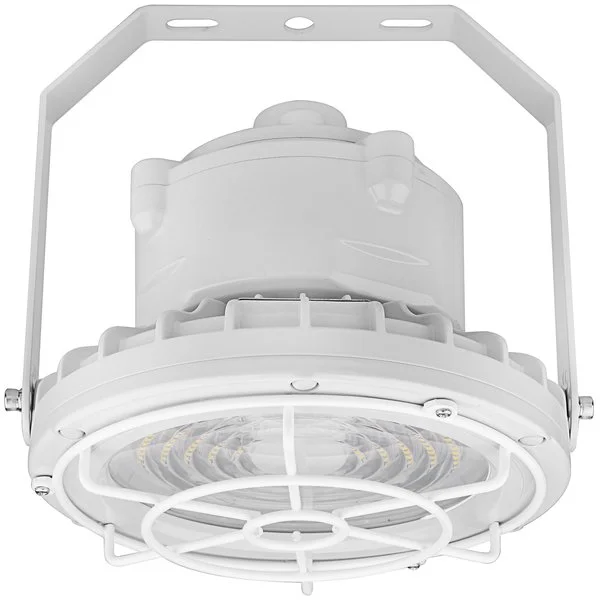
LED Explosion-Proof Fixture - Class 1 Division 2
Industrial-rated Fixtures
Industrial-rated LED bulbs are designed for environments that place additional stress on lighting systems.
This includes:
Food processing plants
Cold storage facilities
Dust-heavy manufacturing
Chemical environments
Wash-down areas
Loading docks
These bulbs often include higher IP ratings, more durable housings, and specialized certifications depending on the application.
For example, NSF-certified bulbs may be required in food-related environments, while hazardous-location ratings are necessary in facilities with combustible dust or flammable vapor exposure.
Industrial lighting specifications are usually driven less by aesthetics and more by durability, environmental resistance, and operational reliability.
How to Calculate Proper Brightness
One of the biggest mistakes in commercial high bay projects is choosing bulbs based only on wattage instead of actual lighting performance at floor level.
Brightness in commercial spaces is typically measured using footcandles, which describe how much usable light reaches a surface area below the fixture.
Different applications require different target light levels.
For example:
General warehouse storage areas typically require moderate floor illumination
Picking and packing zones need brighter task visibility
Manufacturing and inspection environments often require even higher light levels
Gyms and retail floors prioritize both brightness and visual comfort
Ceiling height changes everything.
As mounting height increases, light spreads across a larger area before reaching the floor. That means fixture spacing, beam angle, and lumen output must work together to maintain acceptable visibility and uniformity throughout the space.
A narrow-beam fixture may work well at very high ceilings where concentrated downward illumination is necessary. Wider beam angles generally work better at lower mounting heights or in open floor plans where broad coverage is more important.
Uniformity matters just as much as raw brightness.
A warehouse with extremely bright areas directly under bulbs but dark gaps between them creates visibility problems, worker discomfort, and inconsistent floor conditions. Proper fixture spacing and overlapping beam distribution help eliminate those dark zones.
For larger projects, lighting layouts are often modeled before installation to verify expected footcandle levels and fixture spacing.
When it comes to large commercial projects, lighting designers often create photometric layouts before installation. These layouts predict footcandle levels, fixture spacing, beam overlap, and lighting uniformity throughout the space, helping avoid costly installation mistakes before any fixtures are purchased.
1000Bulbs also offers a lighting layout tool directly on product pages below the product description. Users can enter the dimensions of their space to estimate fixture quantity requirements and view projected footcandle levels for the layout.
For larger or more complex projects, 1000Bulbs lighting specialists can also help interpret the results and assist with fixture planning. Give us a call at 1-800-624-4488 to speak to a U.S. based lighting pro.
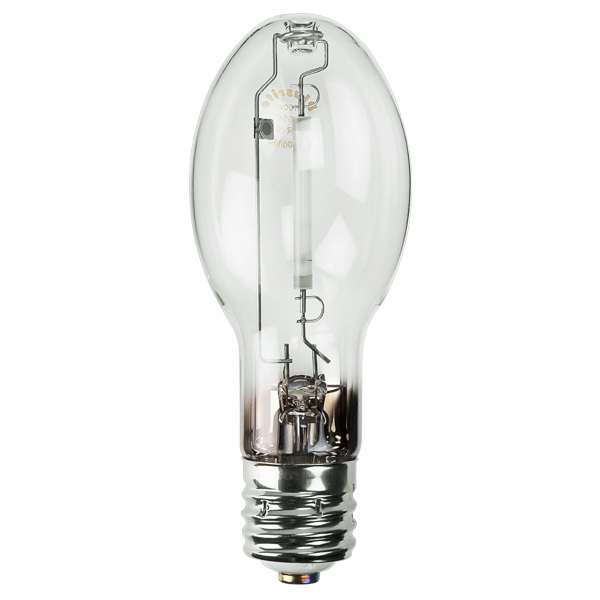
HID Bulb
LED High Bay vs Traditional HID Bulbs
Metal halide and high-pressure sodium bulbs dominated commercial high-ceiling lighting for decades, but LED high bays now outperform them in nearly every major category.
Startup and Restrike Performance
One of the biggest frustrations with older HID systems is restrike time.
After a power interruption, metal halide bulbs may require significant warm-up time before returning to full brightness. LED high bays reach full output almost instantly, which improves operational reliability in active commercial environments.
Energy Efficiency
LED high bays use substantially less energy while producing similar or better usable light output compared to older HID systems.
That reduction becomes especially important in facilities operating:
Hundreds of bulbs
Long daily operating schedules
High-output lighting systems
Large open floor plans
Many commercial facilities see noticeable reductions in lighting-related energy consumption shortly after conversion.
Light Quality and Consistency
Older HID bulbs often lose light output gradually as lamps age, even while continuing to consume the same amount of electricity.
LED high bays maintain more consistent illumination levels over a much longer operating lifespan, which helps improve visibility consistency throughout the facility.
LED systems also provide significantly better color rendering than high-pressure sodium lighting, which is known for its narrow yellow-orange light spectrum. Better color rendering improves:
Product visibility
Worker comfort
Picking accuracy
Safety visibility
Inspection performance
Maintenance Reduction
Maintenance is one of the biggest long-term advantages of LED high bays.
HID systems require recurring lamp replacements along with ballast maintenance over time. In large facilities, lift equipment and labor costs often become just as significant as the fixture hardware itself.
LED high bays eliminate ballast replacement entirely while dramatically extending replacement intervals.
For many warehouses and manufacturing facilities, reducing maintenance frequency becomes one of the primary drivers behind LED conversion projects.

DLC Listing and Rebate Eligibility
Many commercial LED high bays are DLC listed, which is important for utility rebate eligibility.
DLC-qualified bulbs are commonly required for commercial rebate programs offered by utility providers. Before finalizing specifications for a large retrofit project, businesses should verify DLC listing directly through the DLC Qualified Products List rather than relying solely on marketing claims.
Skipping DLC-qualified products can prevent facilities from qualifying for available rebate incentives entirely.
Best Commercial Applications
Different commercial environments require different lighting priorities. Ceiling height alone is not enough to determine the correct fixture specification.
Warehouses
Warehouses and distribution centers are the most common applications for UFO and linear high bay bulbs.
Most facilities prioritize:
Strong floor-level visibility
Consistent aisle illumination
Reduced maintenance
Occupancy sensor integration
Neutral white color temperatures for balanced visibility
Facilities with racked aisle layouts often benefit more from linear high bays aligned along aisle centerlines, while open floor warehouses commonly use UFO bulbs in grid layouts.
Dock door areas and exterior-adjacent zones may also require IP-rated bulbs due to moisture exposure and temperature cycling.
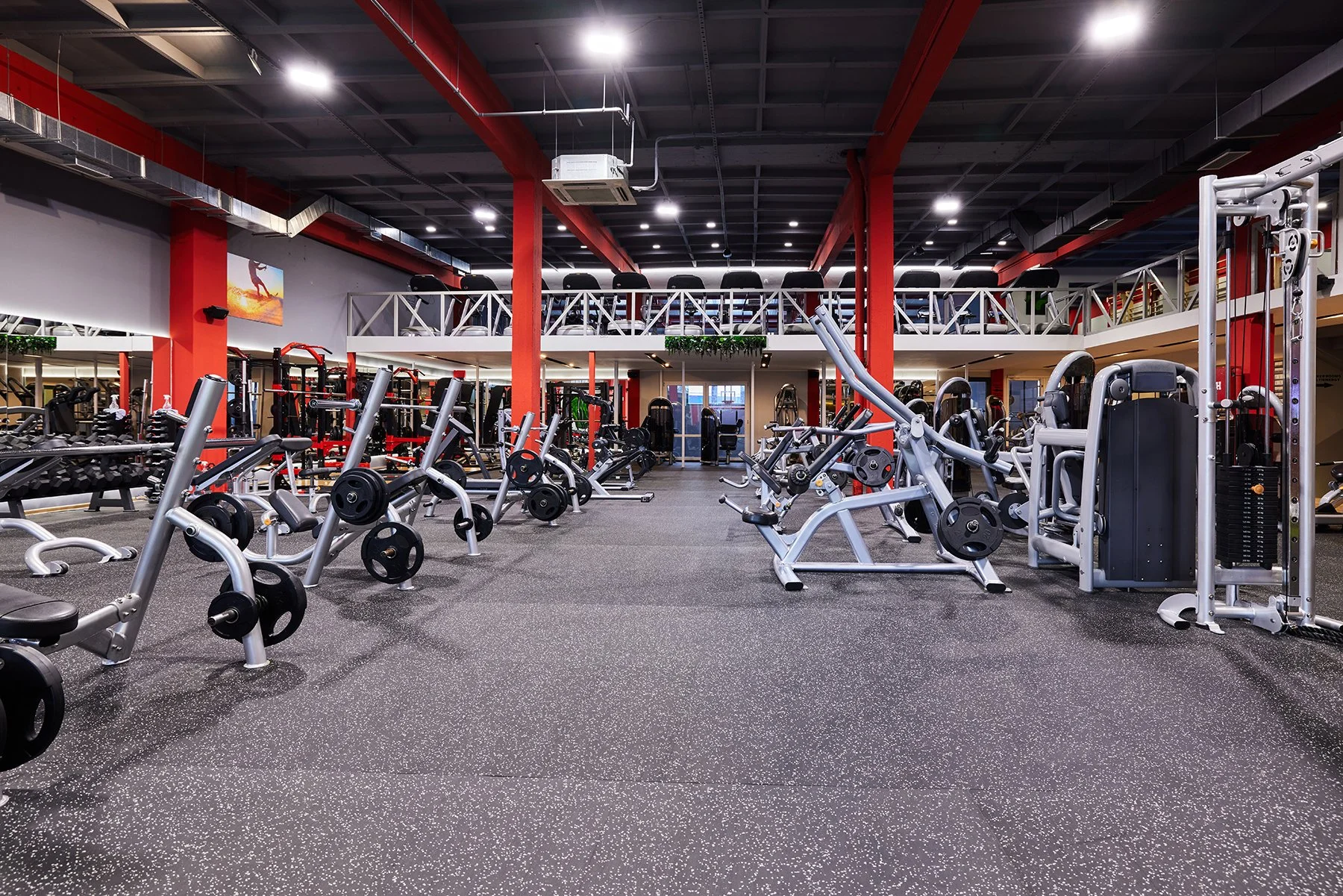
Gyms And Sports Facilities
Gyms and athletic spaces place a heavier emphasis on glare control and visual comfort.
Athletic facilities frequently use:
Linear high bays with diffused lenses
Frosted optics
Dimmable lighting systems
Higher-output bulbs for court visibility
Because athletes regularly look upward during play, glare management becomes much more important than it is in a standard warehouse environment.
Many multi-use gyms also use programmable dimming scenes for events, workouts, and community activities requiring different light levels throughout the day.
Manufacturing Facilities
Manufacturing spaces often require higher footcandle levels and stronger color rendering than general storage environments.
Facilities commonly prioritize:
High CRI lighting
Consistent color temperature
IP-rated protection
Uniform production-line illumination
Reduced shadowing around equipment
Linear high bays are especially common over conveyor systems and production rows where long, consistent light distribution is important.
Quality inspection areas may also require higher-CRI bulbs to improve defect visibility and color accuracy during manufacturing processes.
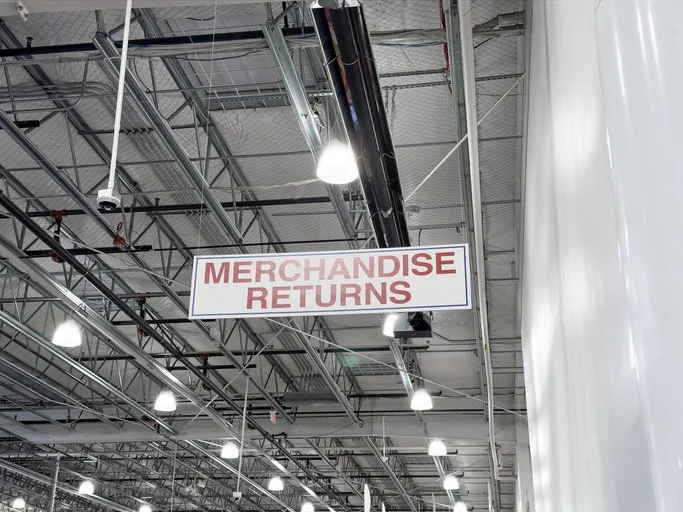
Retail Environments
Large-format retail stores need lighting that balances visibility, product presentation, and long-term operating efficiency.
Retail spaces commonly prioritize:
High CRI lighting for product appearance
Consistent color temperature across fixture types
Strong overall floor illumination
Uniform coverage throughout aisles and displays
Flexible accent lighting integration
Linear high bays are often used for ambient lighting across large open retail floors, while lower-mounted accent bulbs highlight merchandise displays and promotional areas.
Layered lighting strategies are common in retail because they allow stores to create brighter focal points without forcing the entire ceiling system to operate at extremely high light levels.
Consistency matters as well.
Using mismatched color temperatures between high bays, track lighting, and display bulbs can create a visually uncomfortable shopping environment. Many retailers standardize around a consistent neutral white color temperature throughout connected sales areas.
For larger retrofit projects, many retail facilities also prioritize DLC-listed bulbs because rebate eligibility can significantly affect overall project economics.
Energy Savings and ROI Considerations
One of the biggest reasons businesses transition to LED high bays is long-term operating cost reduction.
High-ceiling facilities often operate lighting systems for extended hours every day, which means even moderate efficiency improvements scale quickly across hundreds of bulbs.
LED high bays reduce costs through several combined factors:
Lower electrical consumption
Reduced maintenance requirements
Elimination of ballast replacements
Longer fixture lifespan
Occupancy sensor integration
Reduced downtime for maintenance access
Facilities still operating metal halide or high-pressure sodium systems often see the largest improvements because those older technologies consume substantially more energy while also degrading more aggressively over time.
Maintenance savings are especially important in large commercial spaces.
Replacing bulbs at 25 to 40 feet typically requires lift equipment, labor coordination, and operational downtime. Extending replacement intervals dramatically reduces those recurring costs over the life of the installation.
Utility rebates can also play a major role in overall project ROI.
Many commercial rebate programs require DLC-listed bulbs for eligibility, which is why rebate qualification is often reviewed early during project planning. Depending on the utility provider and project size, rebates can offset a meaningful portion of overall retrofit costs.
Because rebate structures vary widely by region and provider, many businesses evaluate DLC qualification status, fixture efficiency, sensor compatibility, annual operating hours, and maintenance reduction potential before finalizing their lighting specifications.
Common High Ceiling Lighting Mistakes
Even experienced buyers run into problems when specifying lighting for large commercial spaces.
Underestimating Lumen Requirements
One of the most common mistakes is selecting bulbs that simply do not produce enough usable floor-level illumination for the ceiling height involved.
A fixture that looks extremely bright at eye level may still leave dark floors and uneven visibility when mounted 25 or 30 feet overhead.
Ignoring Beam Angle and Spacing
Beam angle matters just as much as wattage.
Narrow beams work well at very high mounting heights where concentrated illumination is necessary. Wider beam spreads generally work better at lower mounting heights or open layouts where broad coverage is preferred.
Incorrect spacing can create:
Dark gaps between bulbs
Uneven floor visibility
Excess glare directly below bulbs
Poor uniformity across the space
Skipping Occupancy Controls
Many warehouses and industrial spaces leave additional energy savings untapped by ignoring occupancy sensors and dimming controls.
Modern sensor-ready bulbs make it relatively simple to automate lower-output lighting levels in storage aisles and low-traffic areas while restoring full brightness instantly when activity is detected.
Overlooking DLC Qualification
DLC listing is one of the most important commercial purchasing details many buyers overlook initially.
Facilities planning to pursue utility rebates should verify DLC qualification directly before purchase. Rebate eligibility often depends entirely on qualifying fixture specifications.
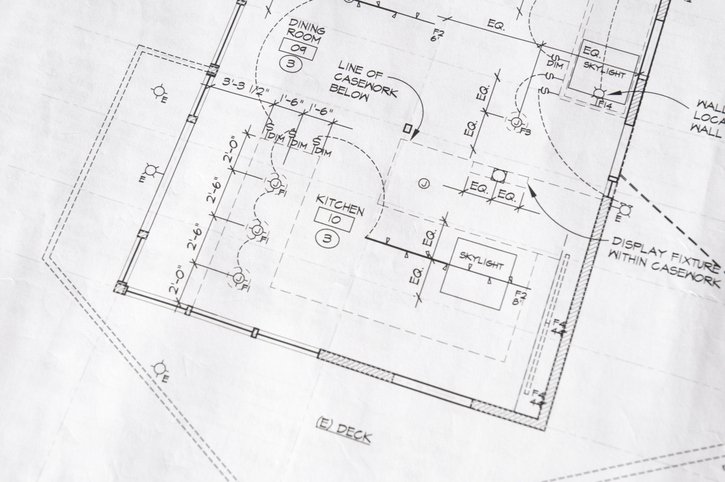
Not Using a Lighting Layout
Large commercial spaces should never rely entirely on guesswork or simple square-footage rules. Photometric layouts help verify fixture quantity, footcandle levels, beam overlap, uniformity ratios, and fixture spacing before installation begins. 1000Bulbs' lighting layout tool can help estimate fixture count and projected footcandle levels directly from product pages, and lighting specialists are available to help interpret the results for more complex commercial spaces.
Lighting Large Spaces More Efficiently
Lighting a high-ceiling commercial space effectively requires more than simply choosing the brightest fixture available.
Successful projects balance:
Ceiling height
Fixture spacing
Beam angle
Footcandle requirements
Rebate eligibility
Maintenance planning
Long-term operational efficiency
The right fixture for a warehouse may not be the best option for a gym, retail environment, or manufacturing floor. Matching the fixture type to the actual application is what produces better visibility, stronger efficiency, and lower long-term maintenance costs.
Modern LED high bays have made large-space lighting far more efficient and easier to maintain than older HID systems ever allowed. Facilities now have access to stronger light quality, better controls integration, longer fixture lifespan, and lower operating costs across nearly every major commercial application.
Whether you are retrofitting an existing facility or planning lighting for a new space, 1000Bulbs carries UFO high bays, linear high bays, industrial bulbs, and commercial LED solutions designed for high-ceiling environments.
Shop LED High Bay Lights or call 1-800-624-4488 to speak with a US-based lighting specialist about your project.
FAQs
What Lights Are Best For High Ceilings?
Commercial LED high bay bulbs are typically the best option for ceilings above roughly 15 feet. UFO high bays work well in open warehouse environments, while linear high bays are often better for aisles, production lines, and organized storage layouts.
How Many Lumens Do Warehouses Need?
Warehouse lumen requirements depend on ceiling height, fixture spacing, and the type of work being performed. General storage areas require less illumination than picking zones, manufacturing areas, or quality inspection stations.
What Is The Best Mounting Height For High Bays?
High bay bulbs are commonly used in spaces with ceilings ranging from approximately 15 to 40 feet, depending on fixture type, wattage, beam angle, and application requirements.
Are LED High Bays Worth It?
For many commercial facilities, LED high bays reduce energy consumption, maintenance frequency, and long-term operating costs significantly compared to older HID systems. The maintenance reduction alone is often a major advantage in high-ceiling environments.
UFO Vs Linear High Bay: Which Is Better?
Neither fixture type is universally better. UFO high bays are ideal for open floor layouts, while linear high bays typically perform better in aisles, conveyor systems, and organized production environments where elongated light distribution improves uniformity.